Nepal (2026)
31 Mar, 2026 | ~2000 words | Also available in: 中文
This post covers the travel portion of my 2026 trip to Nepal for the EBC trek.
Itinerary
- 2026-03-03: Vancouver -> Shanghai
- 2026-03-07: Shanghai -> Chengdu
- 2026-03-09: Chengdu -> Kathmandu
- 2026-03-11: Kathmandu -> Lukla
- 2026-03-21: Lukla -> Kathmandu
- 2026-03-24: Kathmandu -> Kunming
- 2026-03-25: Kunming -> Shanghai
Landing in Kathmandu Again After 9 Years
Nine years later, landing back at Kathmandu Airport brought up a lot of feelings. Although the airport is still pretty rundown, it’s noticeably cleaner and more modern than I remembered from last time. Back then I don’t think visa-on-arrival was a thing, so I had gotten my visa in advance. This time I pre-filled an e-visa form online, and clearing immigration after landing was super smooth—took maybe 30 minutes. After grabbing our luggage, we exchanged a bit of cash and picked up a Nepal Telecom SIM card. The guy at the counter was insanely efficient: we handed him our cash and phones, and he just tapped away and set everything up for us. My phone is in English and my friend’s is an Android in Chinese, but the guy had clearly seen every OS and language imaginable and configured both effortlessly.
From my pre-trip research, I learned you can hail rides with an app called inDrive—another huge change compared to 9 years ago. Ride-hailing apps were already everywhere in China back then, but not here. I remember having to flag down taxis on the street, and communicating was a real hassle. The inDrive app is pretty interesting: you pick a destination, the system suggests a fare (around 450 NPR from the airport to Thamel), and you set your own offer and post it. Nearby drivers receive the request and can either accept your price or counter with a higher bid. Then you view the drivers’ profiles and bids in the app and pick who you want. It sounds a bit complicated, but in practice it’s surprisingly efficient! It was my first time seeing a model like this—talk about getting hit with a dose of Nepali modernization right after landing.
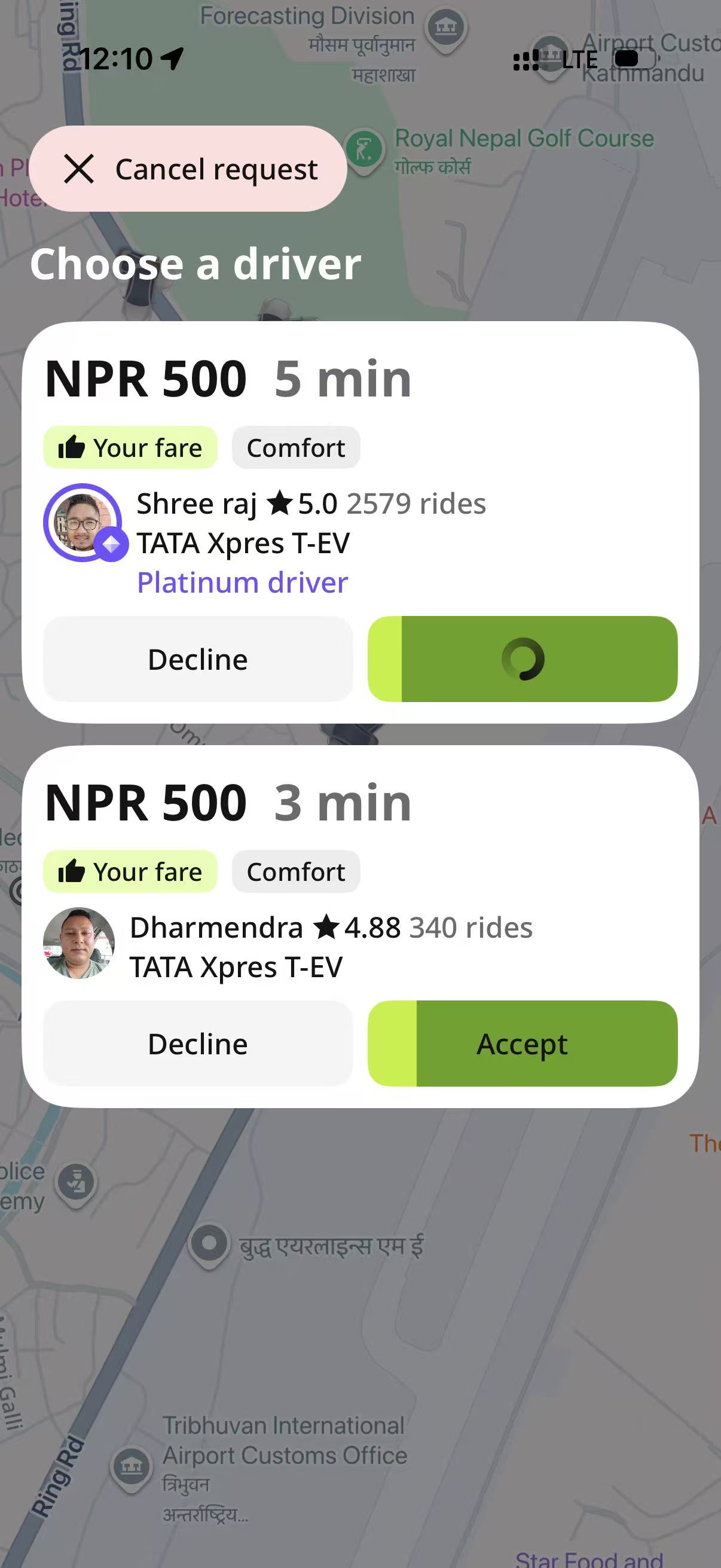
Since we had no idea where at the airport we were supposed to wait for the driver, and drivers here don’t seem to trust GPS pins much, he called us and we went back and forth for a while without him figuring out where we were. Finally he just asked if there was any local nearby and told me to hand the phone over so they could talk😂. After a bit of back-and-forth, he found us. Shoutout to the helpful locals!
Fancy Thamel
Our hotel was booked in Thamel, so we took the cab straight there from the airport. Prices in Kathmandu are genuinely cheap—when I was browsing hotels, there were tons of $10 and $20/night listings that actually looked decent. Though thinking about it, back in college in Shanghai you could also find budget chains like 7 Days Inn for under 100 RMB.
Thamel has both changed and stayed the same. It’s still wall-to-wall shops, still streets lined with The North Face and Arc’teryx—Thamel might honestly have the highest concentration of trekking gear in the world. The biggest difference I noticed this time is that the roads seem much better than before, and the overall environment feels noticeably cleaner. On top of the outdoor gear shops and assorted local stores, there are now quite a few surprisingly upscale-looking cafés. While wandering around aimlessly, we even walked right past “Chengdu Restaurant,” the exact place where I had met up with our former Nepali intern last time!
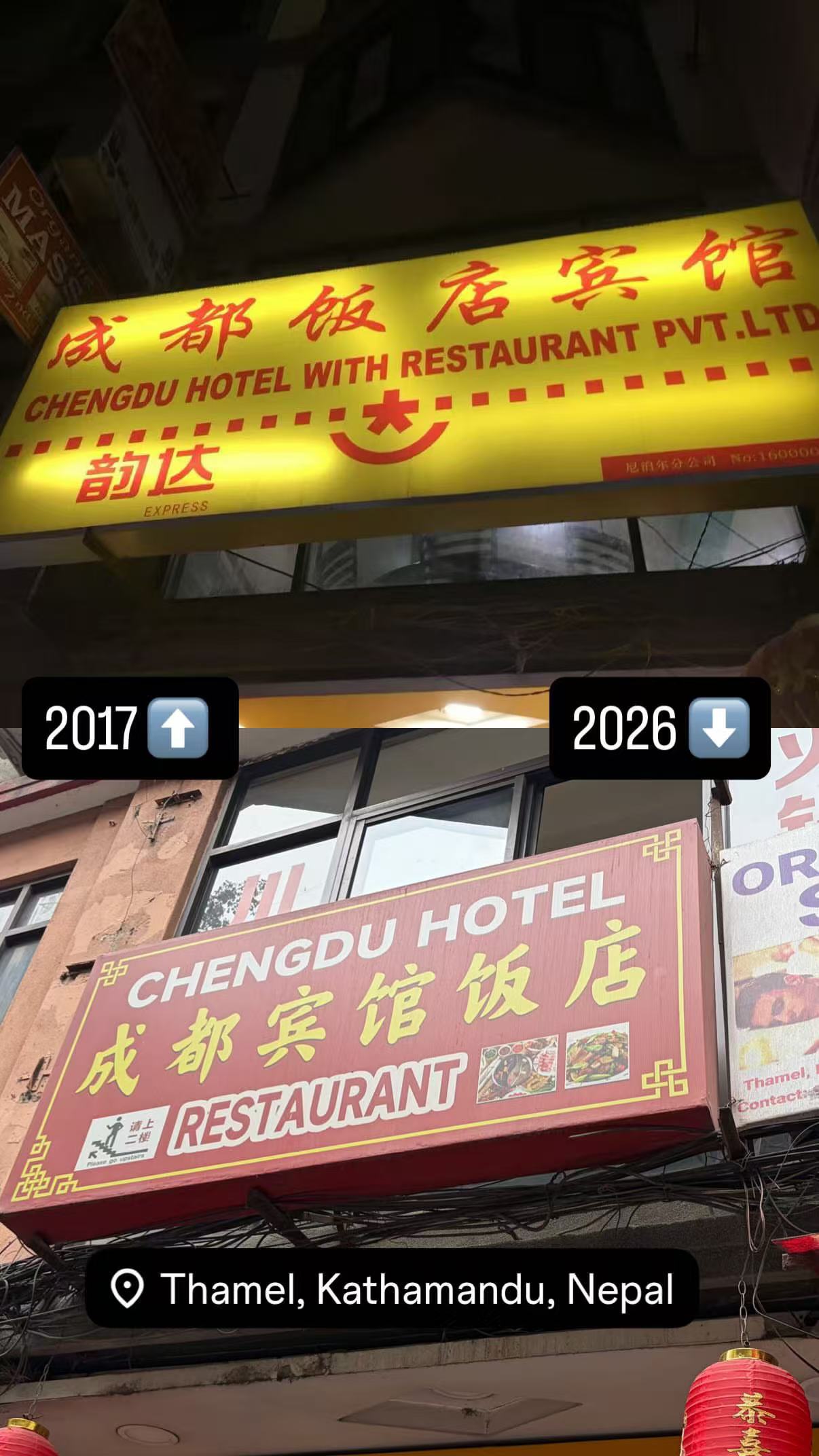
Posts on Xiaohongshu recommended exchanging money with the Chinese owner at a place called “Jiangnan Pharmacy,” saying the exchange rate is better than outside. We budgeted roughly 200 RMB per person per day in the mountains for 20 days, exchanging a little over 80,000 NPR each. Since we’d actually spend at most about 15 days in the mountains, the leftover cash would be about enough for our porter. I had also planned to buy some altitude sickness meds there, but hilariously, this fairly large Jiangnan Pharmacy didn’t even sell altitude sickness medication… Looking closer, it turned out their main business is selling Indian Viagra😂😂😂. Guess these days, if you want to make money, you still gotta target men’s weak spots. Though to be fair, Viagra does dilate blood vessels and boost circulation, so in theory it really can help relieve altitude sickness.
If I hadn’t been worried about how awkward it would be to explain to a female travel companion why I was secretly popping blue pills, I honestly might have bought some to try.
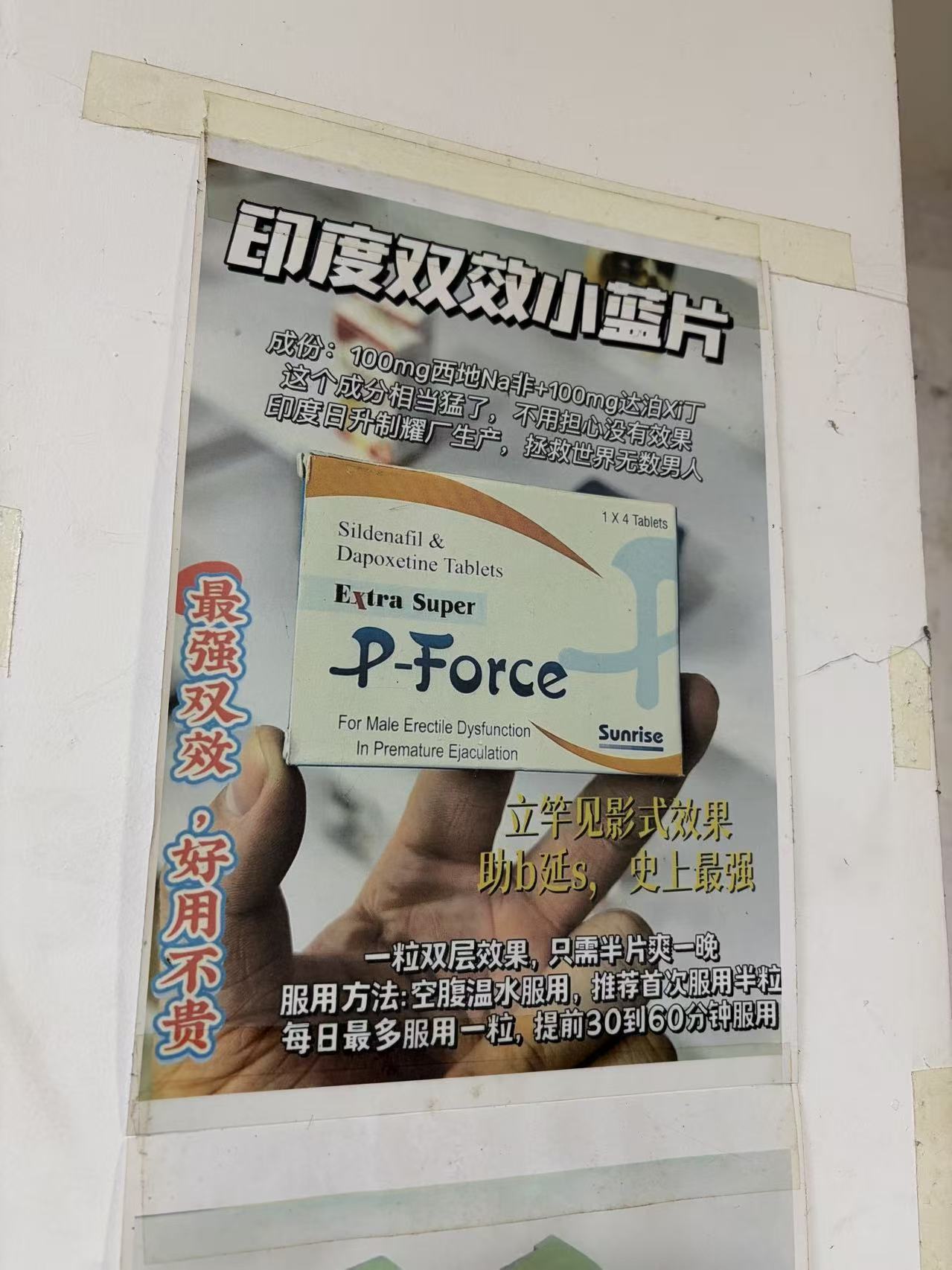
(That slogan is way too tempting!)
In the end we stopped by a nearby Himalaya Java Coffee to sit down and grab a bite. I didn’t expect the decor and vibe to be indistinguishable from a Starbucks or Tim Hortons back home—and the staff’s English completely blows away any coffee shop in China, Japan, or Korea😂.
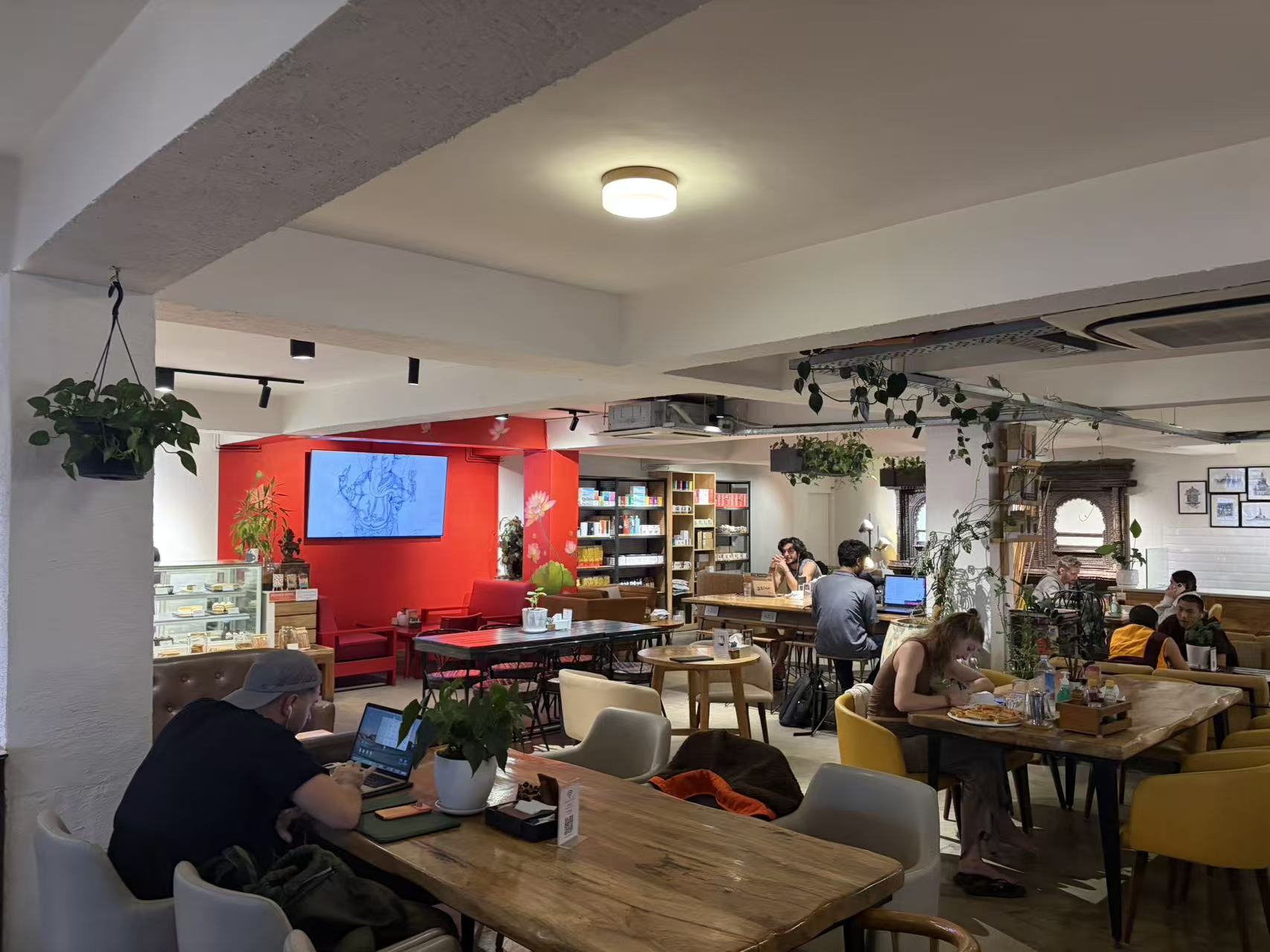
A latte here is around 20 RMB, with pastries and light bites in the same price range. That’s definitely pricey by local standards, but my friend and I were genuinely impressed by how visibly Nepal has developed over the past few years—at least I don’t remember seeing places this nice last time we were here.
Cars and Traffic
All of Kathmandu sits in a valley surrounded by mountains on every side, kind of like a miniature version of Sichuan. The core urban area is basically enclosed within a 7 km-diameter ring road—even smaller than Chengdu’s First Ring Road. Yet packed into this tiny area is a population density Chengdu can’t even come close to. I checked Wikipedia and it’s around 17,000 people per square kilometer. If that number doesn’t mean much on its own, for comparison, Chengdu’s population density is 1,100/km²—an entire order of magnitude lower😂. With that many people and almost no public transit, Kathmandu has the most bizarre yet weirdly efficient traffic system I’ve ever seen (the other extreme city being Cairo, Egypt).
To me, the biggest defining features of Kathmandu traffic are:
- Tons of narrow alleys barely 1.5 cars wide, and winding all over the place instead of mostly straight grids like in China.
- Practically zero traffic lights.
- Mountains of motorcycles and Suzuki Alto-sized microcars, with motorbikes filling every single gap around the cars.
- Everything seems to be in constant motion—people, cars, motorbikes. No matter how packed it gets, it almost never comes to a complete standstill.
The lack of traffic lights in particular is truly astonishing. Growing up in China, it’s almost impossible to imagine a metro area of 3 million people operating this “efficiently” with barely any traffic lights. You really can’t put that shock into words—you just have to spend a few days in Kathmandu to experience that sensation of perpetual flow.
Because the country is poor and car taxes are super high, you barely see any luxury cars here. From my observations over a few days, the cars in Kathmandu also have very distinct patterns:
- Tons of tiny cars, mostly Suzuki Altos and Tatas. A big chunk of these are probably taxis.
- The share of EVs is surprisingly high—maybe 20%? Yet zero Teslas!
- Among newer-looking cars, there are barely any Japanese brands left; instead, there are quite a few Chinese brands.
- Chinese cars are almost all EVs, with BYD miles ahead in market share, and MG being the other brand you see a lot. Beyond those two, you can spot a few cars from all sorts of other Chinese brands.
- Luxury cars I spotted totaled about three: one Mercedes G-Class, one BMW X7, and an Audi Q5 or Q7.
Eating, Walking, and Exploring
I spent about 4 days in Kathmandu on and off this trip, and roughly explored four areas:
- Thamel
- Kathmandu Durbar Square
- A relatively upscale commercial street district
- Patan Durbar Square
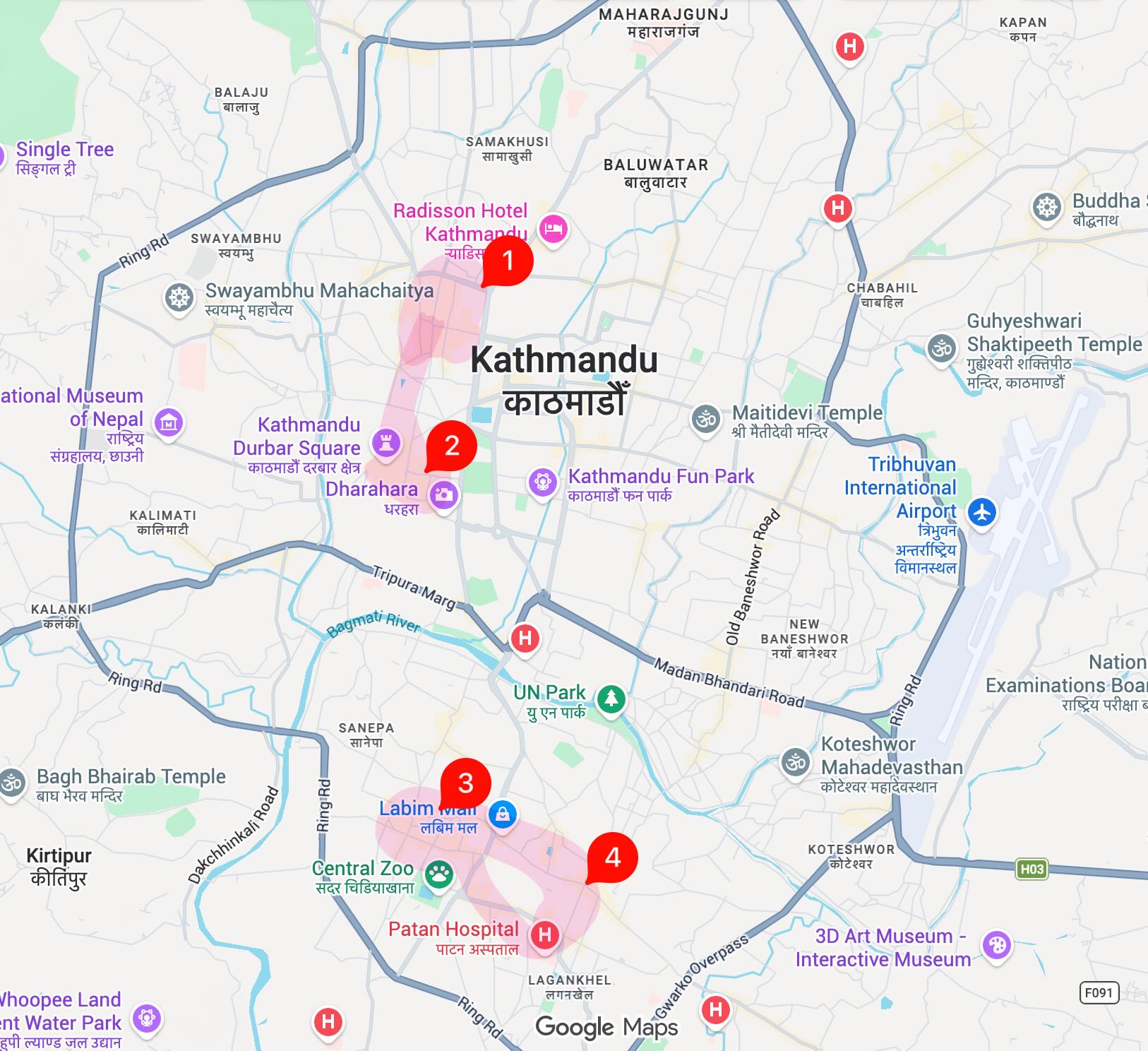
There isn’t much to say about Thamel and Durbar Square, but area #3—the upscale shopping street—was pretty interesting. Even though I know plenty of people in Kathmandu speak English, the vast majority of street signs elsewhere are still written in Nepali. In that commercial district, however, the big storefronts are almost entirely in English, including restaurant menus and outdoor ads. Like this:
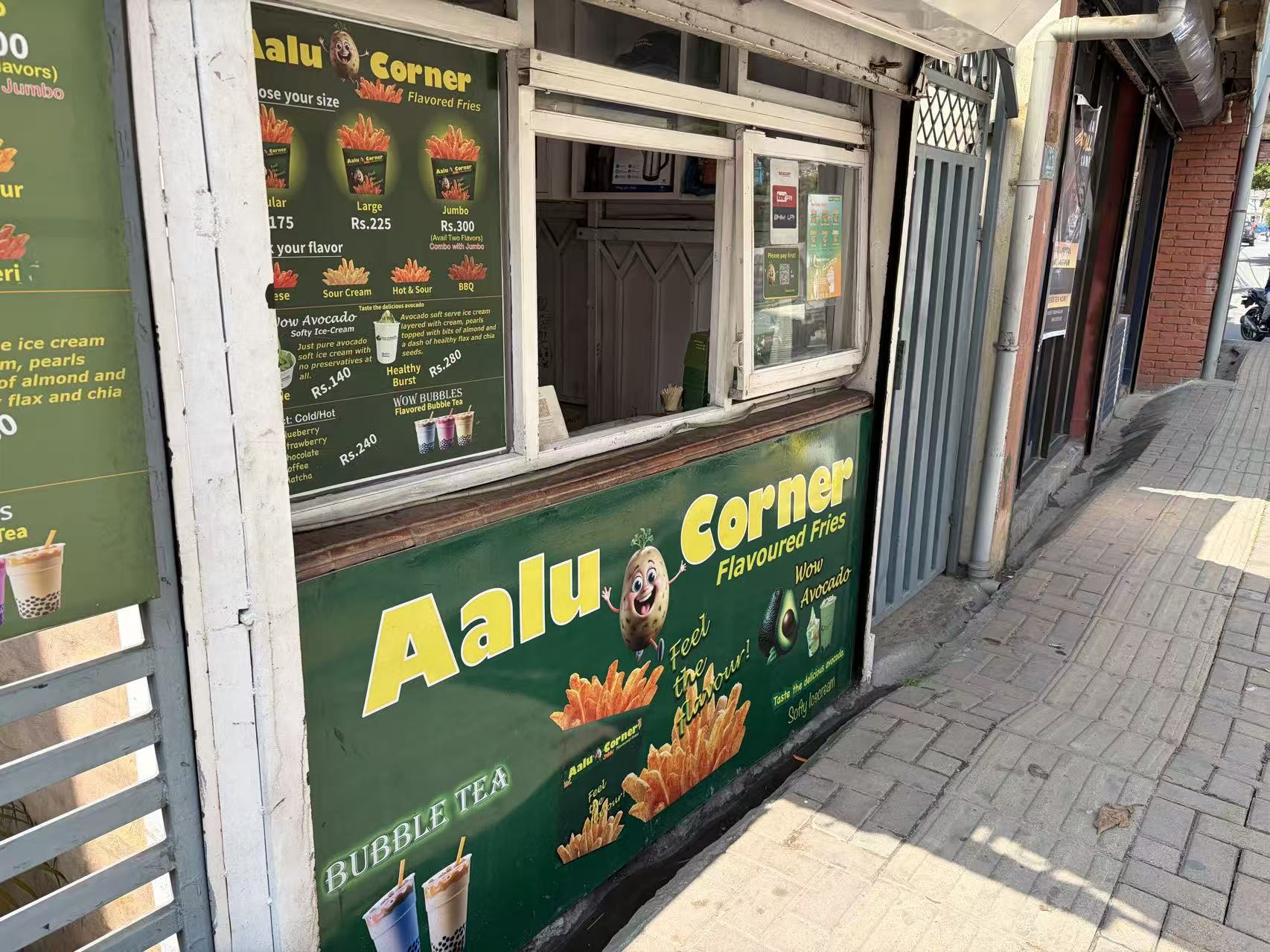
Turns out Beijing isn’t the only “folding” city—Kathmandu is plenty stratified too… Basically, this area isn’t meant for locals who don’t speak English, even if they have money. Beyond the shops, we also passed a lush, well-landscaped school that clearly looked like the kind where local elites send their kids, complete with electrified barbed wire along the perimeter wall. Nearby there’s also a mall called Labim—obviously not on the level of malls in China, but it has Pizza Hut, KFC, and even a big Sony store, so it’s definitely an upscale mall here.
Nearby we also cut through a super chaotic, bustling bazaar-like local alley. It felt a lot like Thamel, except they were selling actual everyday necessities. And these markets are 100% tiny mom-and-pop stalls, with zero mid-sized or larger supermarkets. It feels like everyone in Nepal is a sole proprietor selling something. While it looks lively, it also guarantees low efficiency across society—without economies of scale in procurement, people probably end up paying more for everyday goods. Looking around, even though each little shop sold slightly different things, they all fell into the same handful of categories. I honestly have no idea how locals tell which shop is good and which isn’t…
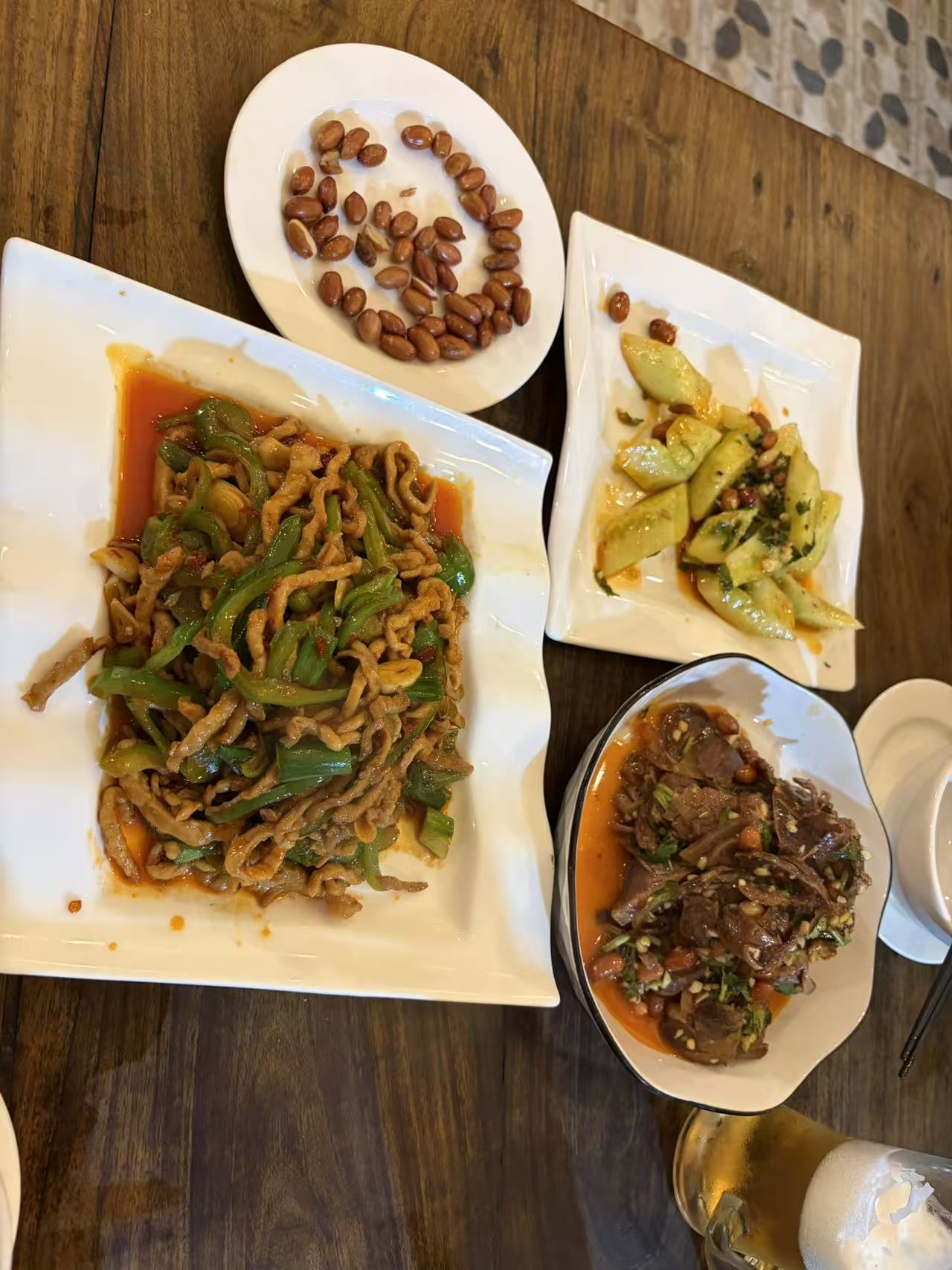
Overall though, Kathmandu is really just a transit hub for travelers, not a sightseeing city, so there’s not all that much to do. What did surprise me, however, was the food over these few days—much better than I expected. A few spots that stood out:
- Nepal Go (小雪的家): In Thamel, a Sichuan restaurant run by locals—the highest-rated Sichuan spot we found on Dianping. The female owner speaks a bit of Chinese. The food is great, especially the chilled spiced beef; the chili oil is insanely fragrant.
- The Sichuan restaurant inside Lakhey Hotel: Right near Thamel. I didn’t have main dishes there, but my friend did and said it was really good too. At the very least, their breakfast is pretty decent.
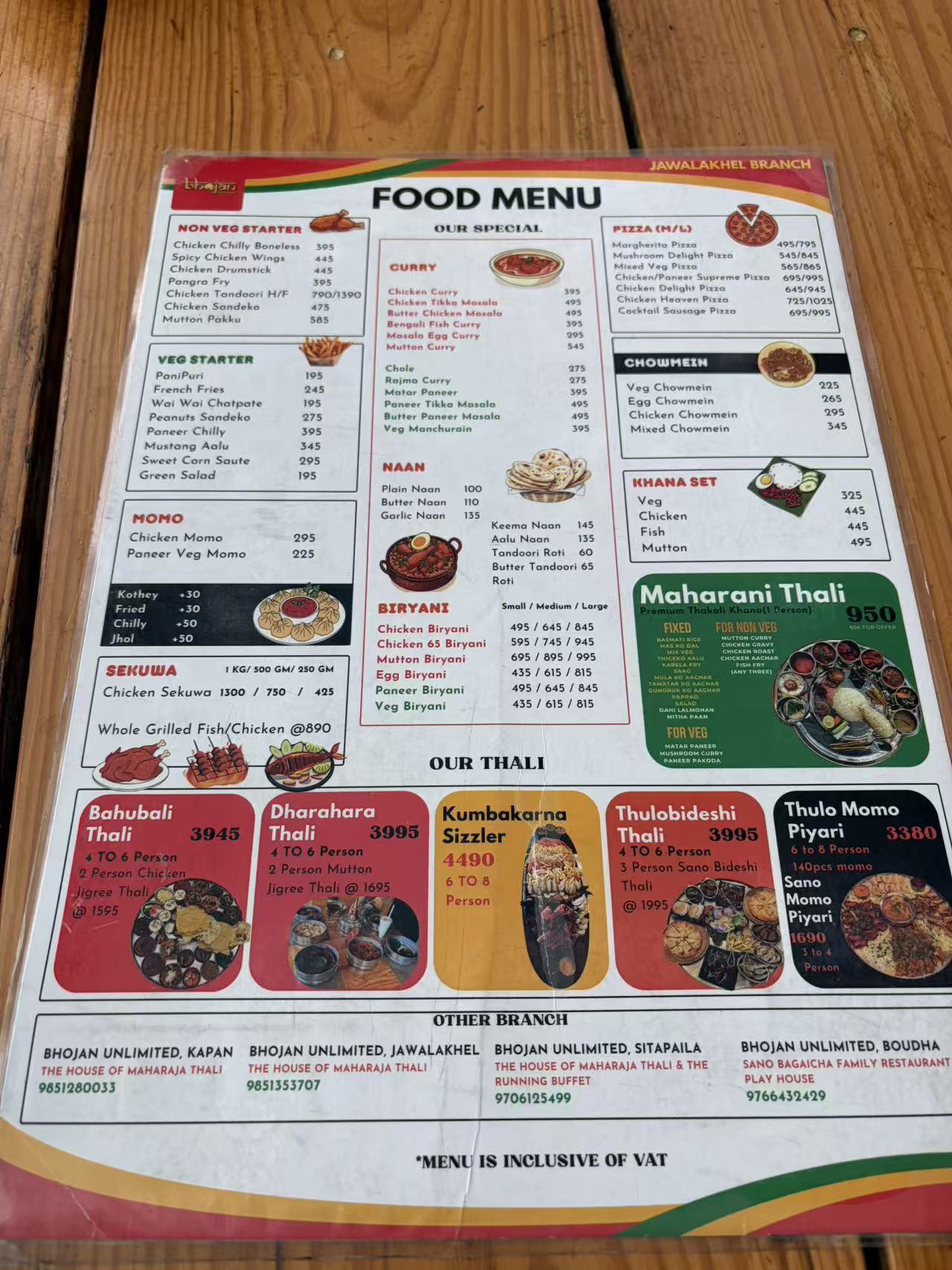
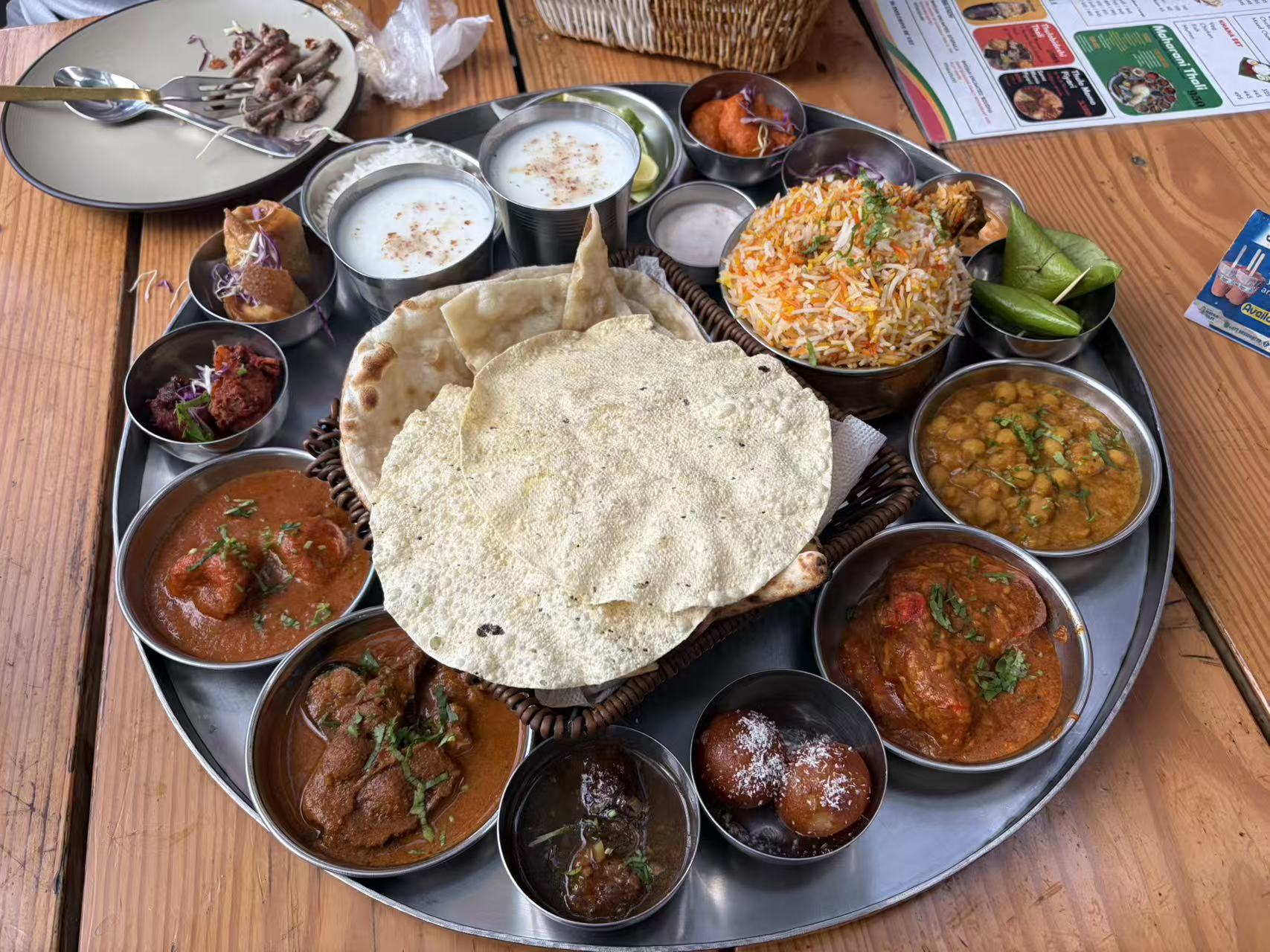
- Bhojan Unlimited: A chain; we went to the branch near Patan. We ordered a 1,600 NPR set meal that came with a mountain of food we couldn’t possibly finish. A few items were a bit wild, but overall it was pretty tasty.
- 4Stories: A Western restaurant in Thamel. The second floor has a super cozy vibe where you can take your shoes off and lounge. Both the coffee and burgers were solid, and the chicken bowl my friend ordered was great too.
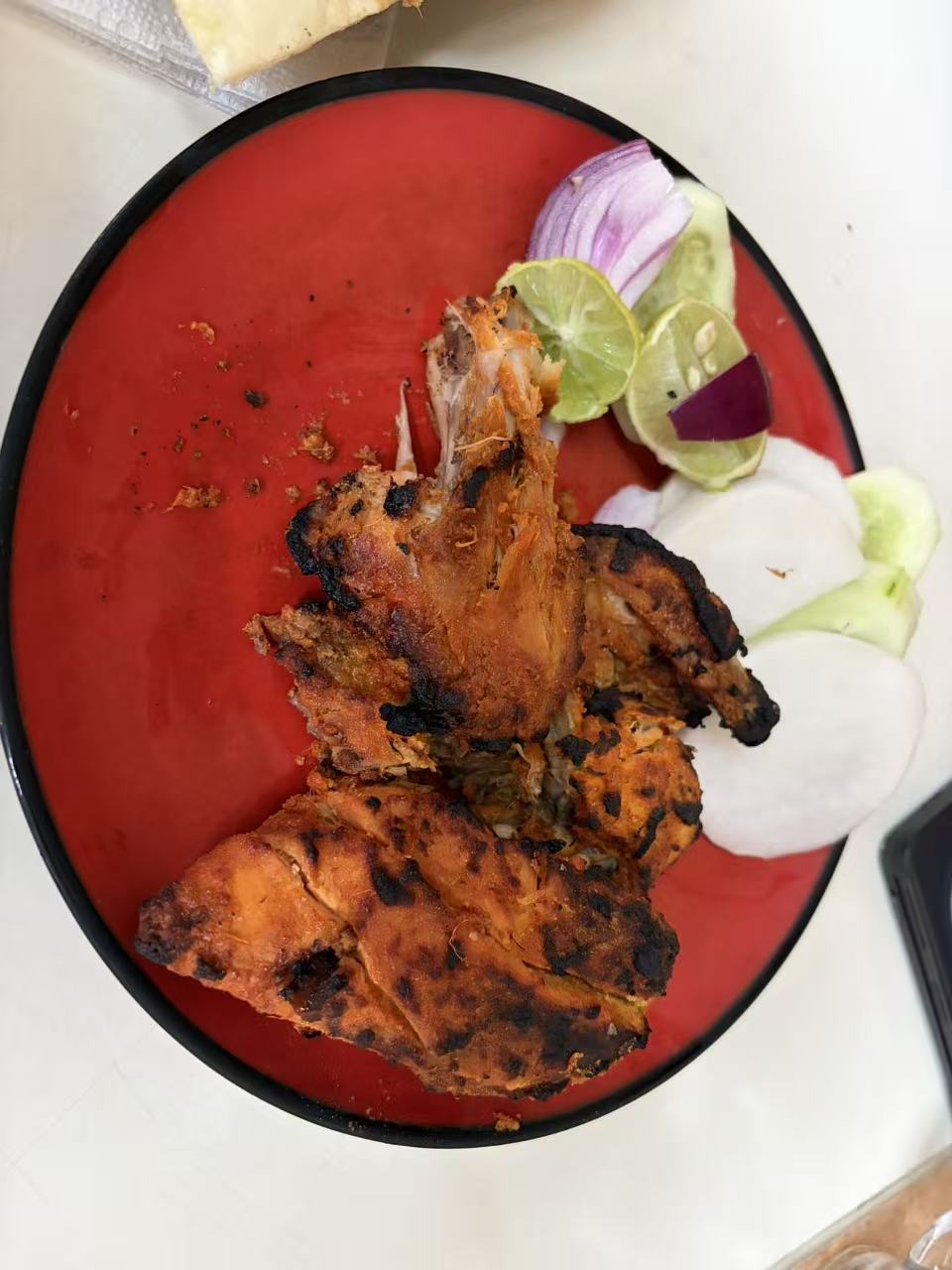
- New Coffee Shop: Near Lakhey Hotel, just outside Thamel. Not 100% sure I got the name right—we literally just walked in at random. We casually ordered Tandoori chicken, and it turned out to be hands-down the best roast chicken we ate the entire trip, packed with flavor.
Other Observations & Thoughts
- Didn’t see any famous bubble tea chains; the only one I recognized was Chatime.
- Prices don’t seem to have changed much from 9 years ago—a dish is still generally 500–700 NPR.
- Restrooms are generally pretty clean, and most have Western-style sit-down toilets.
- Cars drive on the left.
- Use inDrive whenever you can; hailing random taxis on the street is a rip-off.
- English proficiency here is seriously impressive—even a random hole-in-the-wall diner can whip out an English menu on the spot. China, Japan, and Korea should take notes.
- Kathmandu seems to have had zero urban planning—wherever there’s space, people just build a bit more and do whatever they want. In a way, it’s a bottom-up, organically grown city.
- India’s generic pharma industry is no joke—tons of pharmacies in Thamel aggressively hawk Viagra. Men really spend their whole lives stressing over this one thing🤷.
- I tracked down a badminton hall to play a bit. The wooden court was worn down so smooth it practically gleamed—slippery as hell, I was terrified to even run. I randomly played two games with a local guy at the gym, only to find out afterward he’s ranked top 20 in the country.
- In an unfamiliar city, skip the taxis and just walk around looking at the streets—it’s actually really fun.
- I wonder what Tesla Autopilot would turn into if you trained it here.