Nepal - EBC (Everest Base Camp) Trek - Gear
28 Mar, 2026 | ~3000 words | Also available in: 中文
This post covers the gear for my 2026 EBC trek in Nepal.
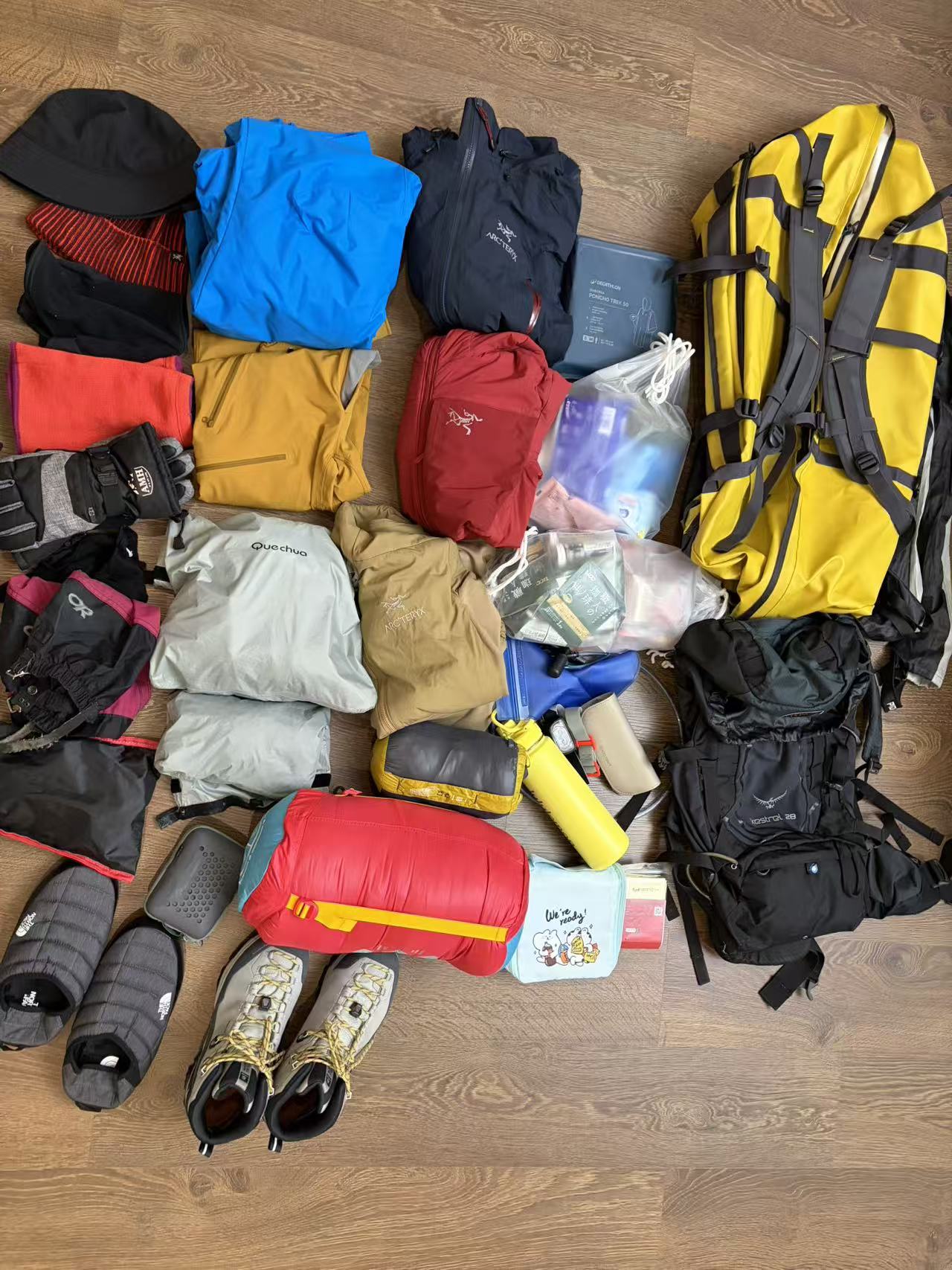
- Gear Mistakes
- Backpacks
- Footwear
- Base Layers
- Mid Layers: Softshell / Light Down
- Outer Layer: Hardshell / Down
- Gloves / Balaclava / Hats
- Other Gear
- Emergency Gear
What to pack for a trek is genuinely a complicated topic. It depends on the route, your own body, your budget, and the weather—there’s no one-size-fits-all checklist you can just copy. Here I’m writing a retrospective based on my own preferences and how things actually played out on EBC. More than the star ratings themselves, I hope to share the thought process and trade-offs behind how I choose gear.
The star ratings here are a holistic score factoring in:
- Value for money: While “you get what you pay for” generally holds true for outdoor gear, if you ignore price, the most expensive stuff will obviously win 5 stars every time. Buying top-of-the-line gear for everything on a standard trail is just total overkill.
- Versatility: If a piece of gear is only useful in one hyper-specific scenario and collects dust the rest of the time, I’ll dock points for that.
- Route fit: EBC is a very well-developed trail with teahouses every night, and temperatures in March are pretty reasonable, so you rarely need hardcore expedition-grade gear.
- Personal bias: As a long-time Vancouver resident, I naturally support the local brand (Arc’teryx > > > > Patagonia 😊).
All prices listed are official retail prices in RMB (¥) or CAD ($) (multiplying CAD by 6 roughly gives the tax-included RMB price). Of course, I bought almost all of my gear on sale—surely nobody pays full retail for everything… right?
Gear Mistakes
Since this is a post-trip review, let’s start by owning up to my mistakes! The single worst piece of gear I brought on this trip was a pair of Columbia ski pants. Even more embarrassing, I actually thought long and hard about it beforehand and convinced myself ski pants were a clever, unconventional-yet-brilliant choice. My logic went like this:
Bringing hardshell pants has way too narrow a use case: they’re miserable to wear when it’s not raining, softshell pants handle light rain fine, and if it’s pouring, I can just take a rest day. On the other hand, if I skip hardshell pants, bringing only down pants doesn’t really work either—if my softshell pants rip, I can’t exactly hike in down pants.
^^ Everything above I still think is totally sound. The problem was what I came up with next:
Ski pants are both waterproof and warm! As a backup pair, I can wear them if it pours or if my softshell pants tear, AND wear them around camp to stay warm. They’re the perfect 2-in-1 replacement for hardshell + down pants.
I’ll give you a minute to spot the flaw in this logic.
.
.
.
.
The biggest thing I overlooked: I can easily stuff hardshell pants into my daypack, whereas ski pants are a giant bulky lump—there’s no way you’re carrying them around on your back for quick changes.
On top of that, it’s not even that cold while you’re moving on the trail—hiking in ski pants would have been a sauna. And even around camp, they’re nowhere near as warm, comfortable, or convenient as down pants.
The other piece of gear I should have brought but didn’t was a heavy down jacket. Even though you don’t really need it while hiking (even up to EBC itself), having a thick down jacket at the teahouses would have made evenings so much more comfortable. Without one, I had to layer a pile of clothes every single night, which was super annoying.
Backpacks
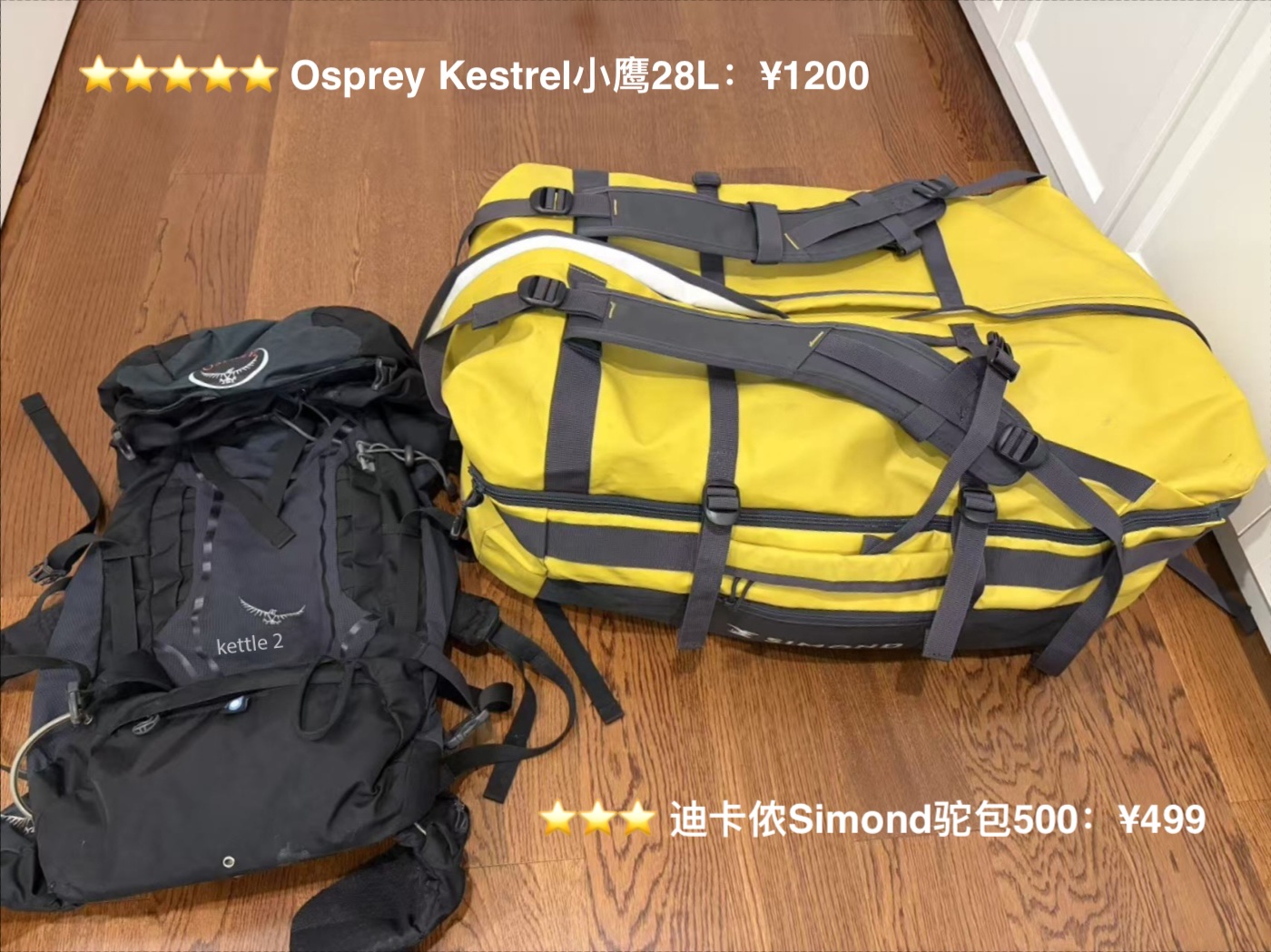
- ★★★★★ Osprey Kestrel 28L: ¥1,200
- ★★★☆☆ Decathlon Simond Duffel Bag 500: ¥499
Considering how often you use it and what it costs, a good backpack is hands-down the single most worthwhile piece of gear to spend money on. I bought this Osprey back in 2016 from Amazon Global for ¥750. Multi-day treks, day hikes, even the occasional city outing—it does it all. Over the past 10 years I’ve easily carried it more than 100 times, and judging by its current condition, it’ll easily last another 5 to 10 years. Insane value for the money.
I strongly recommend getting a 20–30L pack for everyday/general use—it’s the sweet spot with tons of versatility. I’d also advise against ultralight packs, because they make pretty big compromises on suspension, max load, and durability. I also own an Osprey Levity 45; even though it fits all my solo overnight camping gear and weighs less (0.8 kg) than the Kestrel (1.2 kg), I almost never touch it outside of that one use case.
I picked up the Decathlon duffel right before EBC. Originally I was going to bring my 65L backpack, but traveling with two backpacks is a pain, and I’d never owned a proper duffel before, so I figured I’d try something new and grab the Decathlon one.
Overall I’m very happy with it—the weight, build quality, and little design details are all solid, and it definitely punches above its price. When you have a porter, a duffel is way more convenient than a backpack: every evening when you get to the teahouse, you unzip it and everything is laid out right in front of you. With a backpack, unpacking and repacking every single day gets tedious.
The only reason I gave it 3 stars is that it can’t really replace a backpack, and its use cases are relatively narrow. If you already own a large backpack, there’s not much need to buy a duffel.
Footwear
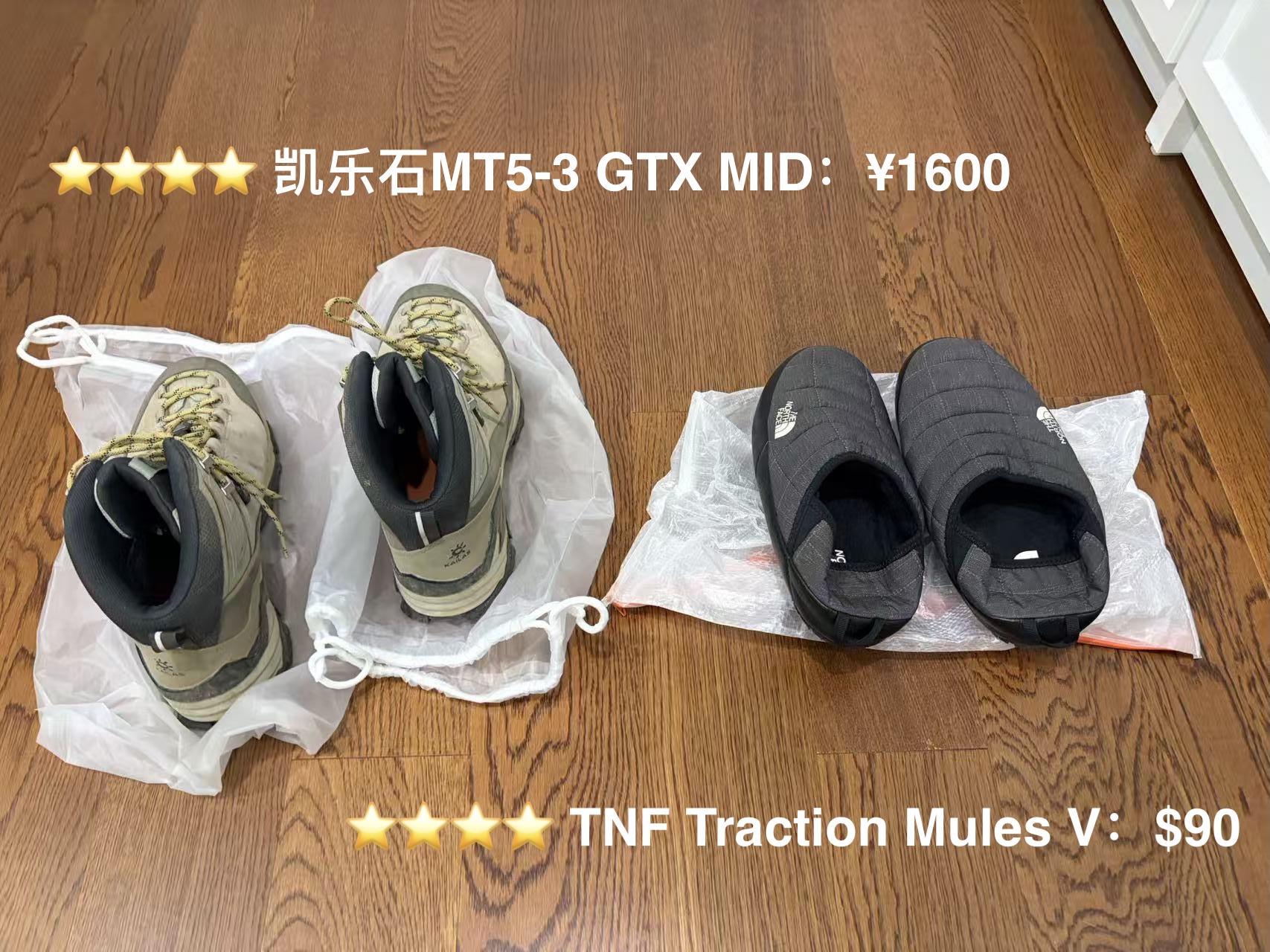
- ★★★★☆ Kailas MT5-3 GTX MID: ¥1,600
- ★★★★☆ The North Face Traction Mules V: $90
I probably don’t need to preach about how important good boots are for a multi-day trek. Given how long they last, a solid pair of boots is well worth the investment. My previous pair were Lowa Renegades, which also lasted me nearly 10 years until the rubber outsoles were pretty worn down. On a recent trip back to China I noticed Kailas has moved upmarket with a great reputation, so I decided to support a domestic brand and grabbed a pair. Aside from the Kailas, I also tried on:
- Salomon Quest 4 GTX: Solid all-rounder, definitely a safe buy.
- Merrell Moab 3 Mid: Lacking in support—especially around the forefoot, which felt a bit flimsy. The upside is they’re relatively cheap.
- Hoka Kaha 3: Felt really good when I tried them on! But the salesperson was too busy to pay attention to me. If they’d glanced my way even once, I probably would’ve bought these.
- Decathlon MH500: Way too stiff, though the price is undeniably great.
Whether to go with mid-cut boots for protection or low-cut shoes for lightness is mostly personal preference. Mid-cut boots do have a narrower use case—you rarely need them for low-elevation day hikes—which is really the only reason I can only give these (or any mid-cut boot) 4 stars here. That aside, the MT5-3 is a genuinely great boot, and I’m really glad to see a Chinese brand able to command a premium price instead of being stuck in a race to the bottom on budget gear.
The TNF mules are amazing for camp! Warm enough, super lightweight, even slightly water-resistant! Pair them with a thick pair of socks and they’re the ultimate rest-time companion. Four stars only because they’re not cheap.
Base Layers
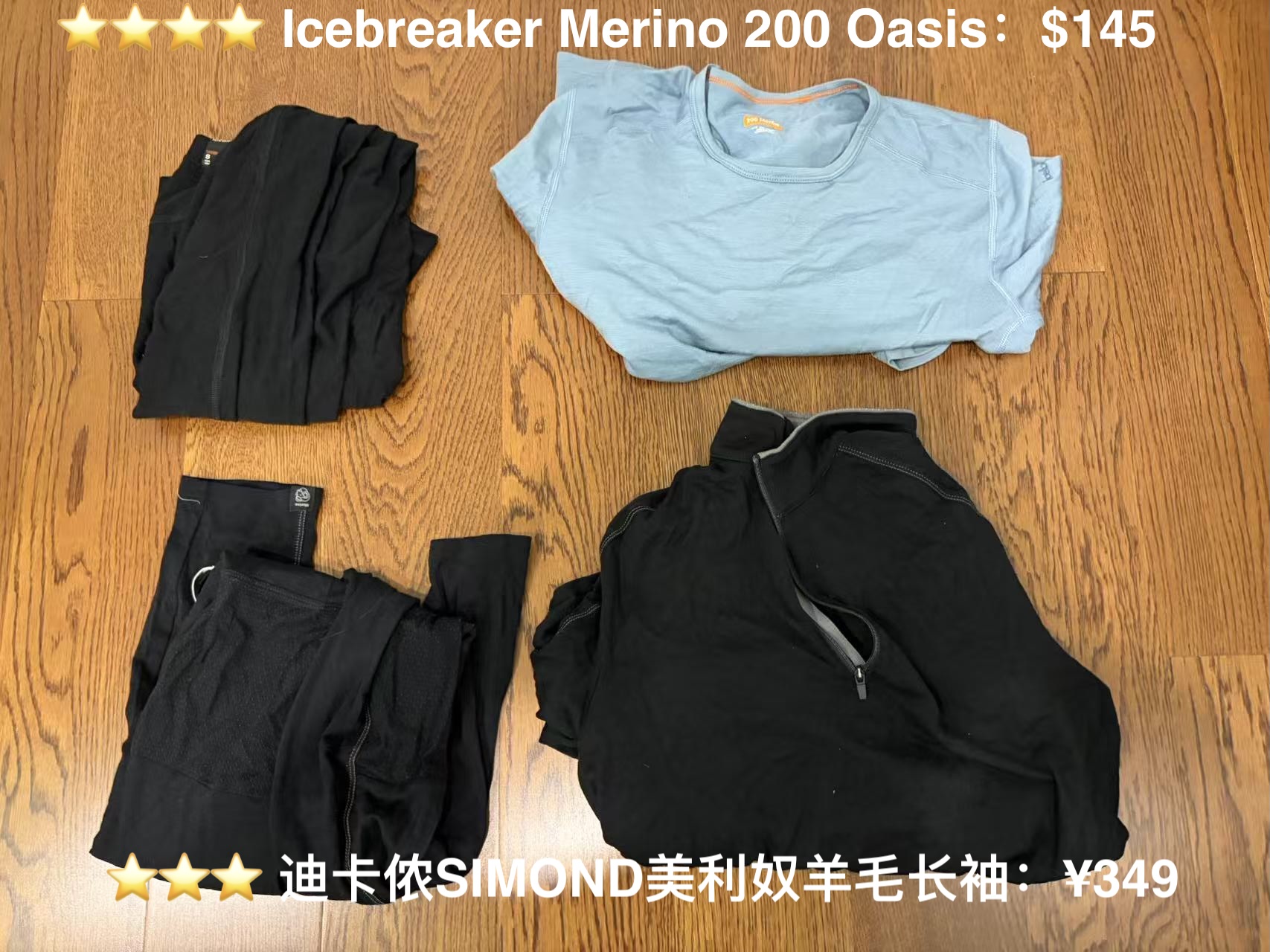
- ★★★★☆ Icebreaker Merino 200 Oasis: $145 (same price for both top and bottom)
- ★★★☆☆ Decathlon Simond Merino Wool Long-Sleeve Trekking T-Shirt: ¥349 (bottoms are slightly cheaper)
“You get what you pay for” is no joke! This was my first time buying merino wool base layers, so I deliberately bought a Decathlon set as well to compare. I have to admit, the Icebreaker feels way more comfortable on the skin 😂. Purely on performance, I didn’t notice a huge gap—the Icebreaker seemed to wick sweat slightly better (though maybe I just sweated more in the Decathlon because I wore it at lower elevations?). I wore each top for 5 days straight and neither really smelled. The main difference really comes down to next-to-skin comfort, so if you’re on a budget, Decathlon is totally fine.
I won’t rehash the merino vs. synthetic pros and cons—you can ask any AI and get a solid answer. For a multi-day high-altitude trek like this, though, I do think having at least one merino set is well worth it.
Also, one pair of base-layer bottoms is plenty. Across the entire 10-day trek, I only wore my merino leggings on the Lobuche-to-EBC day. Every other day, a single pair of hiking pants was enough. Of course, that depends on your cold tolerance—some friends in our group were hiking in three layers of pants every single day 😧.
Mid Layers: Softshell / Light Down
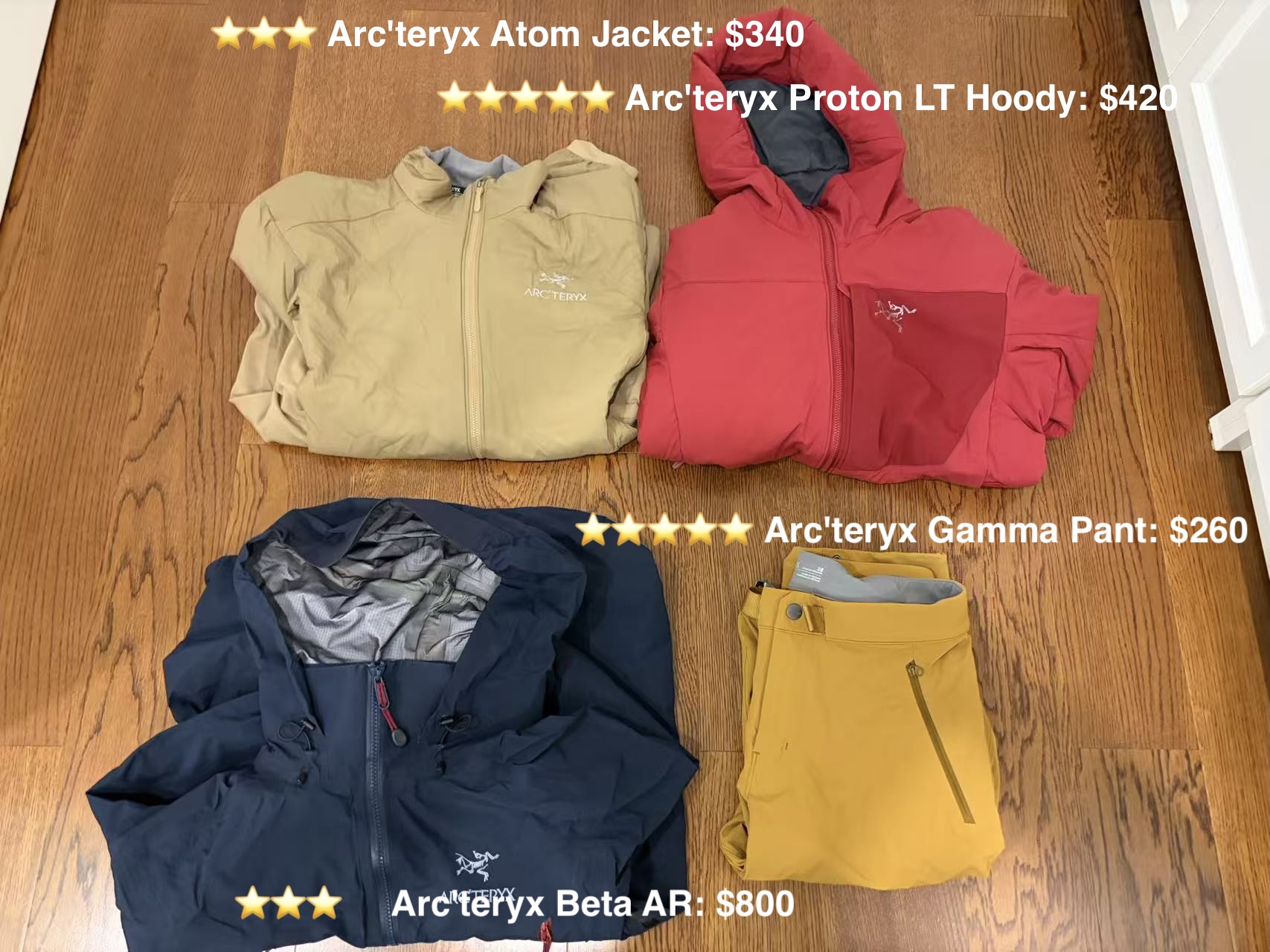
- ★★★★★ Arc’teryx Proton LT Hoody: $420
- ★★★☆☆ Arc’teryx Atom Jacket: $340
- ★★★★★ Arc’teryx Gamma Pant: $260
- ★★★★☆ Highrock (forget the model) baffle down jacket: forgot the price, probably around ¥300?
The Proton series is technically aimed more at climbing, but I wear mine constantly both in the city and on the trail. Reasonable price, great breathability, warmth, and abrasion resistance—reapply DWR now and then and it even handles brief light rain without breaking a sweat. Overall, it’s a true jack-of-all-trades. I wore it 80% of the time on EBC. If I had to pick a flaw, the pockets sit at waist level, so they’re a bit awkward to open with a backpack hipbelt on.
There’s nothing wrong with the Atom itself—it’s light, comfy, and warm. The only issue is that the face fabric is so fragile that I only dare wear it as a mid-layer underneath something else. Buying an outdoor jacket and then constantly worrying about babying it feels completely backwards.
The Highrock lightweight down jacket was a last-minute purchase years ago before my Wusun trek. Don’t remember the exact price, just that it was cheap. Even though I don’t wear it often, I’ve packed it for every cold-weather trip for years. At that price and longevity, 4 stars is an easy call. Hilariously, when I pulled it out today I noticed the inside tag says “Since 1982 From Canada”… wait, is this the legendary Arc’teryx OEM factory?!
The Gamma Pant is one of my all-time favorite pieces of outdoor gear. A lot of hiking pants (especially the ones loaded with cargo pockets) just aren’t that comfortable—either they get clammy the second you sweat, or the fabric chafes your legs. The Gamma has none of those issues. The fabric + DWR handles 80% of rainy conditions, the stretch is awesome with zero restriction, and while 3 pockets is slightly on the light side, it’s not a big deal. The only minor drawbacks are the slim fit (so it’s a bit unforgiving on body shape 😂) and the narrow cuffs, which won’t fit over hiking boots.
Either way, these pants are a 6-out-of-5 in my book. They were practically welded to my legs for all 10 days of EBC.
Outer Layer: Hardshell / Down
- ★★★☆☆ Arc’teryx Beta AR: $800
In my opinion, a hardshell is the least necessary thing to splurge on—especially on a well-established trail like EBC. If you’re not crossing high passes, a cheap poncho might honestly be more practical than an expensive hardshell. After all, if the weather gets truly awful, you’re better off just staying an extra day at the teahouse instead of suffering through it for no reason. So a hardshell is really more of an emergency life-saver sitting in your pack.
Maybe we just got lucky, but over the entire 10 days we barely ran into heavy rain or snow while hiking. Honestly, in this season, the odds of precipitation between 7 a.m. and 2 p.m. are pretty low anyway. I carried this hardshell in my pack for 10 days and only pulled it out twice:
- On the stretch from Lobuche to Pheriche, the valley wind was so brutal that my softshell and beanie couldn’t cut it, so I threw on the hardshell as a windbreaker (and it worked instantly).
- In the final 15 minutes of the last day descending from Namche to Lukla, it started pouring. Figuring “I hauled this thing around for 10 days, I might as well get some use out of it,” I put it on for the homestretch.
So back to my original point: 3 stars isn’t because the jacket is bad—it’s because you barely use it. The Beta AR itself is basically the gold standard for an everyday-wearable hardshell.
Underwear & Socks
- ★★★☆☆ Decathlon Merino Wool Underwear: ¥99
- ★★★☆☆ Basic athletic quick-dry underwear × 3: Bought at Costco, cheap
- ★★★★★ Icebreaker Hike+ Light Crew × 2: $56
- ★★★★☆ Icebreaker Hike+ Medium Crew × 2: $56
- ★★★★☆ Smartwool super-thick socks (forgot the model): $?
I definitely went on a merino wool shopping spree for this trip—since you can’t easily do laundry for days on end, I didn’t want to stink too badly… Still, I realized on the trail that I’d underpacked underwear (I’d planned to change every 2 days), so I ended up washing them whenever I got the chance. I was actually a bit worried about wool underwear, since even nice wool can sometimes feel slightly itchy, and itchy underwear would pretty much ruin a hike. Thankfully, the Decathlon pair didn’t feel uncomfortable at all (though not noticeably more comfortable than quick-dry either). As for whether it actually resists odor better—I didn’t exactly take it off after a few days to do a sniff test 😂.
As for socks, merino wool really is super comfortable and warm! For EBC temperatures, the Light version is actually enough. I only wore the Mediums for two days: on EBC summit day they were spot on, and on the first day descending my feet were already getting a bit warm and sweaty in them… That said, because the Light socks are thinner, my boots felt a tiny bit roomy in them, which led to a bit of rubbing. The thick Smartwool socks became my dedicated camp socks—super plush, warm, and cozy.
Gloves / Balaclava / Hats
- ★★★☆☆ Random no-name ski gloves from Amazon: $ super cheap
- ★☆☆☆☆ Icebreaker 200 Oasis Glove Liners: $50
- ★★★☆☆ Random no-name ski balaclava from Amazon: $ super cheap
- ★★★★★ Decathlon neck gaiter: ¥ super cheap
- ★★★★☆ Random Decathlon sun hat: ¥80
- ★★★★☆ Arc’teryx Ribbed Toque: $80
I brought two pairs of gloves: the Icebreaker merino liners and a pair of cheap ski gloves I’d bought randomly ages ago. The Icebreaker liners were easily my worst purchase—$50 is not cheap, and they are way too thin! Why on earth did I buy merino wool for glove liners anyway? So dumb. And the dumbest part of all: I lost them after wearing them once (I literally lose a pair of gloves on every single trek). The ski gloves are a bit awkward—you really do want them on EBC day so your hands don’t freeze, but outside of that one day you basically never need them…
For my head I packed four items: a basic Decathlon hiking hat for sun protection, the Arc’teryx wool beanie, a neck gaiter for warmth, and a balaclava as backup in case it got freezing. In practice, the neck gaiter saw insane mileage—I basically never took it off at night or once we got above the snowline. Having both a warm beanie and a sun hat is essential too; above the snowline you’ll want the beanie on pretty much nonstop. On the descent day the wind was so fierce I even had to throw my hardshell hood over the beanie. Plus, from personal experience, strong wind blasting your head noticeably worsens altitude headaches. Definitely take care to keep your head warm and shielded from the wind.
Other Trekking Gear
- ★★★★☆ Pioneer trekking poles: ¥200–300
- ★★★★☆ Decathlon Forclaz MT500 2L hydration bladder: ¥70
- ★★★★☆ Sea to Summit Tek Towel: $40
I’ve never really understood what makes expensive trekking poles worth the money. I’ve tried a friend’s ~$200 Black Diamond poles and honestly couldn’t tell much difference from my ¥200 Taobao pair… This is already my second set of Pioneer poles—after finishing ABC I gave my first pair to our porter without a second thought and just bought a new pair when I got home! I doubt I’d be that generous with $200 poles 😂.
Honestly, I’m surprised how many hikers still don’t use a hydration bladder. It’s a piece of gear I strongly recommend everyone get. Being able to take a couple of sips whenever you want—instead of waiting for a rest stop to dig a bottle out of your pack and chug—makes hydration so much more efficient. The only downside to this Decathlon bladder is that it permanently has a faint plastic taste… but for 70 RMB, you can’t really complain. I previously bought a ~$60 Platypus bladder in Vancouver—not only did the bite valve have no dust cover, it somehow started leaking after a single year, which was ridiculous. You’re way better off sticking with Decathlon and just tossing it for a new one every couple of years.
I’d owned a small Sea to Summit quick-dry towel before and loved how handy it was, until I lost it in South America. This time I got the medium size and it’s even better—big enough to actually dry off after a shower, and still super easy to carry around.
Emergency Gear
The way I define emergency gear: stuff you’ll almost never use, yet must carry anyway. And it has to stay in your daypack—putting it in your duffel bag defeats the whole purpose.
- Rain poncho: Extra layer of protection if a real downpour or blizzard hits.
- Emergency blanket: Prevents hypothermia in severe rain or snow.
- Headlamp: In case you ever end up hiking after dark.