Japan
07 Jul, 2025 | ~2300 words | Also available in: 中文
As of today, I’ve been to Japan 6 times and covered most areas west of Tokyo (still missing Shikoku). First, let’s drop the travel map to set the tone!
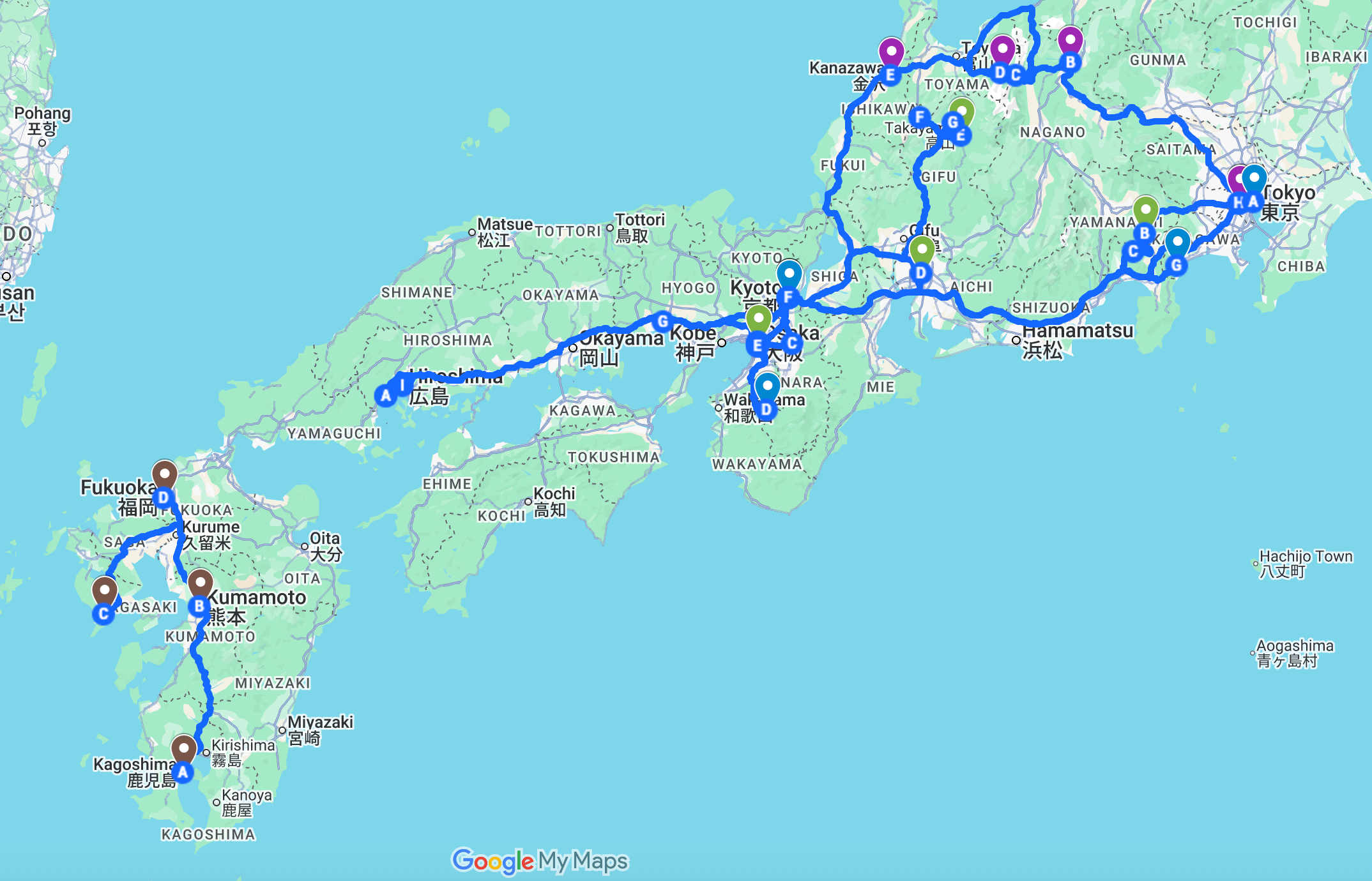
Table of Contents
Cities & Attractions
Tokyo
The center of the universe—what else is there to say? It combines Hong Kong’s population density with Shanghai’s sheer scale; there’s truly nowhere else like it on earth. Doing Tokyo is mostly about eating and shopping, and you can easily fill 3 days just exploring the city. For shopping, most mid-to-large stores take Alipay, UnionPay, and Amex. The only thing to keep in mind is you need to spend ¥5,500+ at a single store to qualify for tax-free.
Tokyo hotel rooms are terrifyingly tiny—always check the square meterage before booking. 10–15 m² rooms are everywhere, guaranteed to leave you with zero space to even open your suitcase. Staying along the JR Yamanote Line is generally the most convenient, since it connects all of Tokyo’s biggest hubs (Ueno, Shinjuku, Shibuya, Tokyo Station, etc.). That said, Japan’s subway system can be pretty confusing: when can you buy a single ticket all the way to your destination, versus when do you have to exit and re-enter because it’s a different operator? Sometimes ticket machines take credit cards, sometimes cash only. Either way, leave plenty of extra buffer time for things like airport trips so you don’t get ambushed by the subway.
- From Narita Airport to downtown, you can take the NEX or Skyliner straight to the JR Yamanote Line—both take about 50 minutes and cost around ¥250. Base subway fare is around ¥170; if you’re hitting multiple stops, consider a day pass.
- Coin lockers are everywhere, roughly ¥400–900 per day depending on size.
- Kichijoji: A very chill, artsy neighborhood—great for half a day or a full day. Lots of Studio Ghibli stuff, including the Ghibli Museum. Inokashira Park and its zoo are also nice for a stroll.
- Ebisu & Meguro: Also great neighborhoods with lots of Western restaurants. Ebisu Garden Place has a free 38th-floor observation deck worth checking out. The “restaurant you must eat at before turning 30” from the Japanese drama Tokyo Girl (Tokyo Joshi Zukan) is right there in Ebisu Garden Place.
- Shinjuku: Tons of places to browse and great for shopping. Kabukicho feels pretty chaotic though—probably won’t stay there next time. Shinjuku Gyoen is the real-life setting for The Garden of Words, worth a visit.
- Shibuya: Very similar to Shinjuku—way too many people! Shopping is super comprehensive though.
- Omotesando: Streetwear and luxury brands—not really my scene.
- Ikebukuro: Hotels tend to be a bit cheaper here.
- Akihabara: What’s left to say? Anime/otaku mecca.
Anywhere along the Yamanote Line is solid—maybe consider around Ueno?
Kyoto
Probably my favorite city in Japan. While Tokyo is one of a kind, it’s ultimately a supercharged version of Shanghai, Hong Kong, or New York. Kyoto, though—I genuinely can’t think of another city like it. It’s filled with temples, and the traditional, old-world atmosphere radiating throughout the city is truly unique in the world. Sure, there are plenty of areas where you can tell the “ancient charm” is deliberately curated (like Shijo), but it doesn’t feel overly forced or off-putting. That said, every time I’ve been to Kyoto I’ve just hit the famous landmarks, so I’m still not sure if Kyoto even has a modern CBD area.
One slight downside to Kyoto is that most of its famous sights are religious—temples, shrines, and the like—so after seeing too many, aesthetic fatigue sets in. Another drawback is that Kyoto’s subway is nowhere near Tokyo’s; lots of sights require buses plus walking. And Japanese summers are brutally hot, so you’ll definitely come back a shade darker after a full day out.
- Shijo (四条) sounds identical to “wash feet” (xi jiao) in Sichuan dialect…
- The Gojozaka stop on Bus 206 sounds a lot like ojousama.
- Gion is full of insanely expensive omakase spots, many members-only, and even the ones open to the public are easily ¥10,000+ per person.
- The subway doesn’t reach many places—you’ll need buses for a lot of sights.
- Yasaka Shrine is really pretty at night, with way fewer crowds.
- Climbing all the way to the top of Fushimi Inari Shrine takes about 45 minutes one way, so it’s a bit of a trek. The bottom is packed and hard to get photos, but the crowds thin out the higher you go—save your photo ops for further up. The summit doesn’t have much of a marker or particularly great views, so skipping the very top is totally fine. Halfway up (about 20 minutes in), there’s a crossroads with a few shops where you can sit and rest, and the view overlooking Kyoto city is pretty open from there.
Mount Fuji
Mount Fuji is only open for climbing in summer (July–September). I took the Yoshida Trail, which is about 1,400 meters of elevation gain over 7 kilometers. It’s fairly steep, but thankfully the trail is easy to follow—not paved stone stairs like mountains in China, but well-maintained dirt/rock paths. The main challenges are just the steep incline and the relatively high altitude (starting above 2,000m and topping out near 4,000m). There are restrooms and small huts/shops every hour or two along the way where you can take a breather. I went in regular running shoes, jeans, a T-shirt, and a laptop backpack. Even though I climbed from dawn until dark, there weren’t any major snags to watch out for.
Honestly though, climbing Mount Fuji itself isn’t all that fun. Fuji looks gorgeous from afar, but on the mountain itself there’s basically zero scenery… Any random trail in Vancouver easily beats the views on Mount Fuji. I guess it’s one of those things best admired from a distance.
P.S. You have to listen to Eason Chan’s Under Mount Fuji (Fuji Shan Xia) while at the foot of Mount Fuji.
Mount Koya (Koyasan)
The sacred mountain of Japanese esoteric (Shingon) Buddhism, home to hundreds of temples of all sizes—most of which offer temple lodging (shukubo), though the prices are eye-watering. I booked Soji-in for ¥45,000 a night, dinner and breakfast included. Probably the most famous temple up there is Eko-in; staying there also lets you join some temple activities for free. The town up on the mountain is basically one main street, kind of like an old mountain street in China, just way less commercialized. If you’re into Buddhism and don’t mind spending, staying 2–3 nights up here is actually lovely—just relaxing, strolling between temples, and joining meditation sessions. Aside from the temples, the biggest “attraction” is the massive cemetery (Okunoin) at one end of the main street. It’s huge—even spending an hour only scratches the surface. If you know Japan’s Sengoku period history, you’ll spot plenty of familiar names: Tokugawa Ieyasu, Toyotomi Hideyoshi, Takeda Shingen, Akechi Mitsuhide, etc. Not sure whether they’re actually buried here or if later generations just built memorials for them.
I couldn’t help marveling at how completely different this felt from China’s famous temple mountains like Mount Emei or Mount Qingcheng. The commercial streets at Emei and Qingcheng are super commercial and bustling—walking through them, you barely feel any religious atmosphere, basically no different from any touristy ancient town at the foot of the mountain. Up here, there’s barely any commercial vibe at all; it’s deeply serene, to the point where speaking loudly on the street feels completely out of place. The streets and lodgings are spotlessly clean. The amenities in the temple are simple yet never sloppy, and the meals are meticulously prepared with real care. From that perspective, staying in the mountains back home is a completely different experience.
Getting to Koyasan is a bit of a hassle. From Kyoto, you can take a direct highway bus, about 3 hours one way. From Osaka, take the train from Namba to Gokurakubashi, transfer to the cable car up to Koyasan, and then take a bus to the temples—roughly 2 hours total.
Hakone
Hakone is best known for its hot spring ryokans and the Hakone Ekiden relay race. On clear days, there are several spots to see Mount Fuji—though summer is rainy season around Fuji, so it’s often shrouded in clouds (like on my trip). Before going, check the visibility forecast on fuji-san. Mountain weather changes fast, though: 3 days before I went the forecast looked awful, then the day before it suddenly cleared up.
Hakone breaks down into roughly three areas: Lake Ashi, Gora, and Hakone-Yumoto (the old town). Most onsen hotels are clustered around Hakone-Yumoto and Gora, with a smaller number along Lake Ashi.
There are two main ways in: from the west, take the Shinkansen to Mishima and a bus up to Lake Ashi; from the east, go to Odawara and take the train/bus to Hakone-Yumoto or Gora. You can buy a Hakone Freepass at the base—if you’re spending 2–3 days in the area, it easily pays for itself. Driving back from Hakone to Tokyo is only about 100 km, roughly an hour and a half.
- Lake Ashi: The perk is great hotel views—on a clear day you can see Mount Fuji. Convenience and hot springs probably lag behind the other two areas, though. From Lake Ashi to Gora is about 40 minutes by bus, or you can take the ropeway and transfer to the cable car (though the ropeway frequently closes in high winds).
- Gora: Higher up in the mountains and the central hub connecting Lake Ashi and Hakone-Yumoto. The biggest highlight is the Hakone Open-Air Museum—a brilliantly designed outdoor sculpture museum where I easily spent two hours. Nearby Gora Park is also quite pretty and worth a visit.
- Hakone-Yumoto: Only passed through this time, though it looked packed with onsen hotels as well.
One-Liner Reviews of Everywhere Else (East to West)
- Tateyama Kurobe: The “Japanese Alps.” Winter/spring is really the season to go, though—I went during China’s October National Day holiday and there wasn’t much special scenery.
- Shirakawa-go: Took a bus from Nagoya to Takayama, then onward to Shirakawa-go. If you have the chance, staying overnight right in Shirakawa-go would probably feel amazing.
- Nagoya: Pretty boring; good for transiting and shopping.
- Nara: Buses only, so getting around isn’t super convenient. You can take a direct train from Kyoto, so swinging by for half a day is totally fine.
- Osaka: Pretty boring; good for transiting or shopping.
- Himeji Castle: Gorgeous and totally worth visiting. Exploring the castle takes maybe 1–2 hours, so a half-day trip from Osaka is plenty.
- Hiroshima: Basically just the Peace Memorial Museum; nearby Itsukushima Shrine (Miyajima) is definitely worth a visit, though.
- Kumamoto: Also tiny—basically just Kumamoto Castle. The castle itself is lovely, and there’s tons of Kumamon merch and shows (the shows are mostly parents bringing their kids…).
- Fukuoka: Surprisingly bigger than I expected; the Tenjin area is super lively. Great spot to wrap up a Kyushu trip, very convenient for shopping.
- Kagoshima: Small and not much to do. Couldn’t even figure out where downtown was—just wandered around the JR station and left.
- Nagasaki: Fairly big city with three hubs (JR Urakami, JR Nagasaki, and Hamamachi), though not a ton to do overall—mainly the Atomic Bomb Museum. Nagasaki’s night view is famous, though; take the ropeway up the mountain at night to look around and take photos.
Observations
2025
- People are learning English everywhere.
- Kyoto’s sights are basically all foreigners, and the proportion of foreigners at JR stations is super high too.
- Almost no Teslas on the streets—in 10 full days in Japan, I only spotted 5.
- Gong Cha is everywhere, and Shohei Ohtani is everywhere.
- Summer is SO freaking hot!!!!
2019
- So many bubble tea shops.
2012
- iPhones and Androids were still uncommon; everyone was still using all kinds of domestic Japanese flip phones.
- Japan’s secondhand (chuko) culture is crazy developed—you can buy literally anything used, and most of it is kept in amazing condition.
- Lots of subway ads about women’s employment/careers.
Tips & Things to Know
- A Suica card is essential. Currently (2025), foreign Android phones still can’t add Suica to their digital wallet, which is pretty inconvenient. Beyond transit, you can use Suica at convenience stores, supermarkets, and coin lockers too.
- The Shinkansen is pretty pricey—Tokyo to Osaka one way is around ¥16,000. So if flight prices are similar and you’re visiting both, flying open-jaw (into one, out of the other) saves both money and hassle.
- The JR Pass doesn’t cover the fastest Nozomi trains. Some Shinkansen trains are reserved-seats only, so it’s best to book ahead.
- Many onsens really do ban people with tattoos.
- When ordering at an izakaya, always order a drink first before ordering food.
- Even though the toilets are super high-tech, the toilet paper is almost always single-ply—gives you zero sense of security.
- Mount Fuji with snow vs. without snow is night and day. Snow-capped Fuji is the real deal; without snow it’s honestly pretty underwhelming.
Itinerary
2009-09-15 ~ 09-17
- 09-15: Shanghai -> Tokyo
- 09-16: Tokyo
- 09-17: Tokyo -> USA
2012-08-21 ~ 08-31
- 08-21 EWR -> Tokyo
- 08-22 Tokyo
- 08-23 Tokyo -> Mount Fuji
- 08-24 Climb Mount Fuji
- 08-25 Mount Fuji -> Takayama
- 08-26 Takayama -> Shirakawa-go -> Hida -> Nagoya
- 08-27 Nagoya -> Osaka
- 08-28 Osaka -> Hiroshima -> Itsukushima Shrine -> Osaka
- 08-29 Osaka -> Nara -> Kyoto
- 08-30 Kyoto
- 08-31 Kyoto
2015-10-03 ~ 10-10
- 10-03: PVG -> Tokyo
- 10-04: Tokyo -> Nagano
- 10-05: Tateyama
- 10-06: Tateyama -> Kanazawa
- 10-07: Kanazawa -> Kyoto
- 10-08: Kyoto -> Himeji Castle -> Tokyo
- 10-09: Tokyo
- 10-10: Tokyo -> Shanghai
2016-08-24 ~ 08-29
- 08-24: Shanghai -> Kagoshima
- 08-25: Kagoshima -> Kumamoto
- 08-26: Kumamoto -> Nagasaki
- 08-27: Nagasaki
- 08-28: Nagasaki -> Fukuoka
- 08-29: Fukuoka -> Shanghai
2019-12-19 ~ 12-22
- 12-19: YVR -> Tokyo
- 12-20: Tokyo
- 12-21: Tokyo -> Osaka
- 12-22: Osaka -> Chengdu
2025-06-14 ~ 06-23
- 06-14: YVR -> Tokyo
- 06-15: Tokyo
- 06-16: Tokyo
- 06-17: Tokyo -> Kyoto
- 06-18: Kyoto
- 06-19: Kyoto -> Koyasan
- 06-20: Koyasan -> Kyoto
- 06-21: Kyoto -> Hakone
- 06-22: Hakone
- 06-23: Hakone -> Tokyo -> YVR