Shanxi
06 Oct, 2026 | ~3800 words | Also available in: 中文
In my memory, Shanxi has always been a rather low-profile province. Growing up, my main impression of Shanxi was “coal bosses” (even though I didn’t actually know any—just the classic stereotype), and once environmental protection became a big push, the phrase “coal boss” mostly disappeared from social media and the news. Shanxi was also never a travel destination I had ever considered. Thinking about it honestly, if you had asked me back then to name a single tourist attraction in Shanxi, I probably couldn’t have named one😂. I might have heard of places like Pingyao Ancient City, sure, but I genuinely didn’t know they were in Shanxi.
In recent years, my impression of Shanxi has shifted more toward cultural stuff. My favorite documentary filmmaker, Zhou Hao, made a film called Datong (also known as The Chinese Mayor). Since it’s been pulled from Douban, I won’t say too much about it here—here’s the IMDB link if you’re curious. Quick aside: I absolutely adore his film Using (“Long Ge”) and recommend it to everyone I meet. Besides Zhou Hao, the other icon of Shanxi is director Jia Zhangke. Many of his films were shot in Shanxi—the small county towns in his early movies like Xiao Wu and Platform capture the atmosphere of that era so well.
Ever since Black Myth: Wukong blew up, Shanxi travel has been popping up way more often on social media. Places like the Yingxian Wooden Pagoda were completely off my radar until I saw them on Xiaohongshu much later. One of my favorite Bilibili film YouTubers, “Dianying Zui Top,” also put out a Shanxi travel vlog series last year, and I shamelessly copied a lot of my itinerary straight from his vlogs.
Beyond the trip report itself, I also jotted down my thoughts on road tripping in China and on cities in Shanxi.
Itinerary
- 2026-09-30 Day 1: Datong -> Yungang Grottoes -> Hanging Temple
- 2026-10-01 Day 2: Yingxian Wooden Pagoda -> Yanmen Pass -> Shuozhou
- 2026-10-02 Day 3: Laoniuwan -> Youyu
- 2026-10-03 Day 4: Sanshier Great Wall -> Shahukou -> Bataizi Church -> Datong
- 2026-10-04 Day 5: Datong Ancient City -> Taiyuan
- 2026-10-05 Day 6: Jinci Temple
Day 1: Datong -> Yungang Grottoes -> Hanging Temple
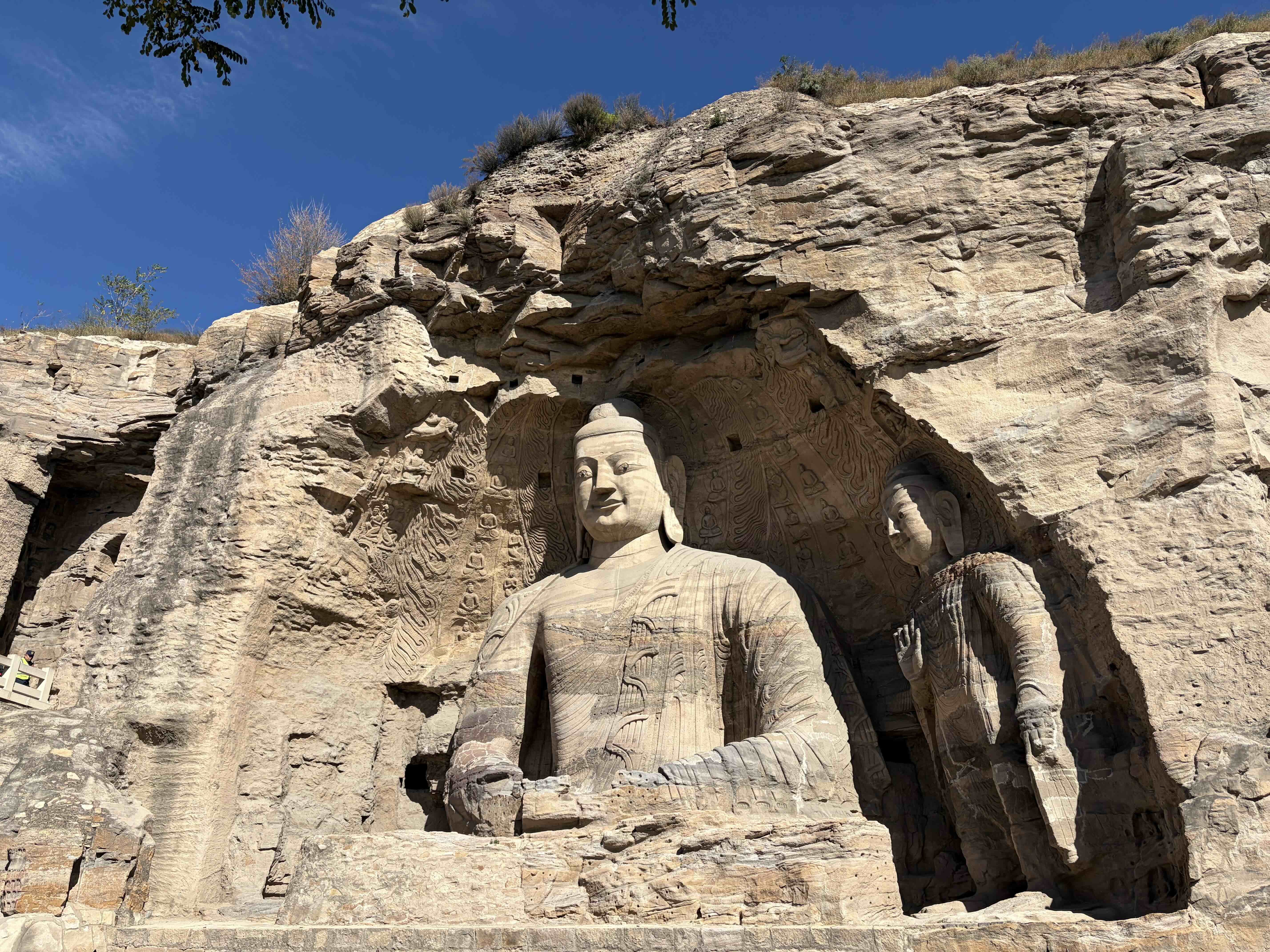
Yungang Grottoes is right next to Datong—about a 30-minute drive without traffic. Today fell between Mid-Autumn Festival and National Day, so in theory the crowds shouldn’t have been too bad. My plan was to leave at 7:30, arrive at 8:00, and be there right when the gates opened. Unexpectedly, we hit some traffic on the way and didn’t arrive until 8:30. By then Parking Lot A near the entrance was already full, so we had to park in B1, which was another 15-minute walk to the visitor center. Luckily, the traffic didn’t seem to be purely from tourist crowds—there was actually zero line to enter the scenic area at that hour.
I had thought about booking a private guide on Xiaohongshu beforehand, but didn’t find anything great. At the visitor center, I spotted a few people splitting an official group guide and smoothly joined in—7 people, 75 RMB each, for about 90 minutes. I strongly recommend hiring a guide either via Xiaohongshu or on-site; otherwise you’ll just be staring at caves without really understanding what you’re looking at. Personally I thought the official scenic-area guide was already great, no need to stress over finding one on Xiaohongshu. Based on my experience, that 75 RMB was worth every penny.
Not much else to say about the grottoes themselves—they definitely live up to their 5A rating. All the caves are lined up along a single path; Cave 6 is the most popular and had the longest line (about 40 minutes based on today’s crowd), while the rest were totally fine. The scenic area is huge, and they’ve awkwardly built a bunch of brand-new attractions right by the entrance, which I personally found pretty pointless. Even our guide said they were newly built so she wouldn’t spend time on them—just glance at them as we walk by😂. We exited around noon and drove straight to the Hanging Temple in Hunyuan County, about an hour and a half away.
Tickets to actually climb up into the Hanging Temple are ridiculously hard to snag—needless to say, I didn’t get one… Without a climbing ticket, you can only look at it from afar at the foot of the cliff, which honestly takes away most of the fun. Also, it seems like scenic spots in China nowadays all use the “admission ticket + mandatory shuttle bus” model to squeeze out more money (or maybe for crowd control?). If you’re driving yourself, you have to park at the visitor center, queue for a shuttle bus to the actual sight, and queue again on the way back. Even though the shuttles run frequently, adding an extra step is just kind of annoying.
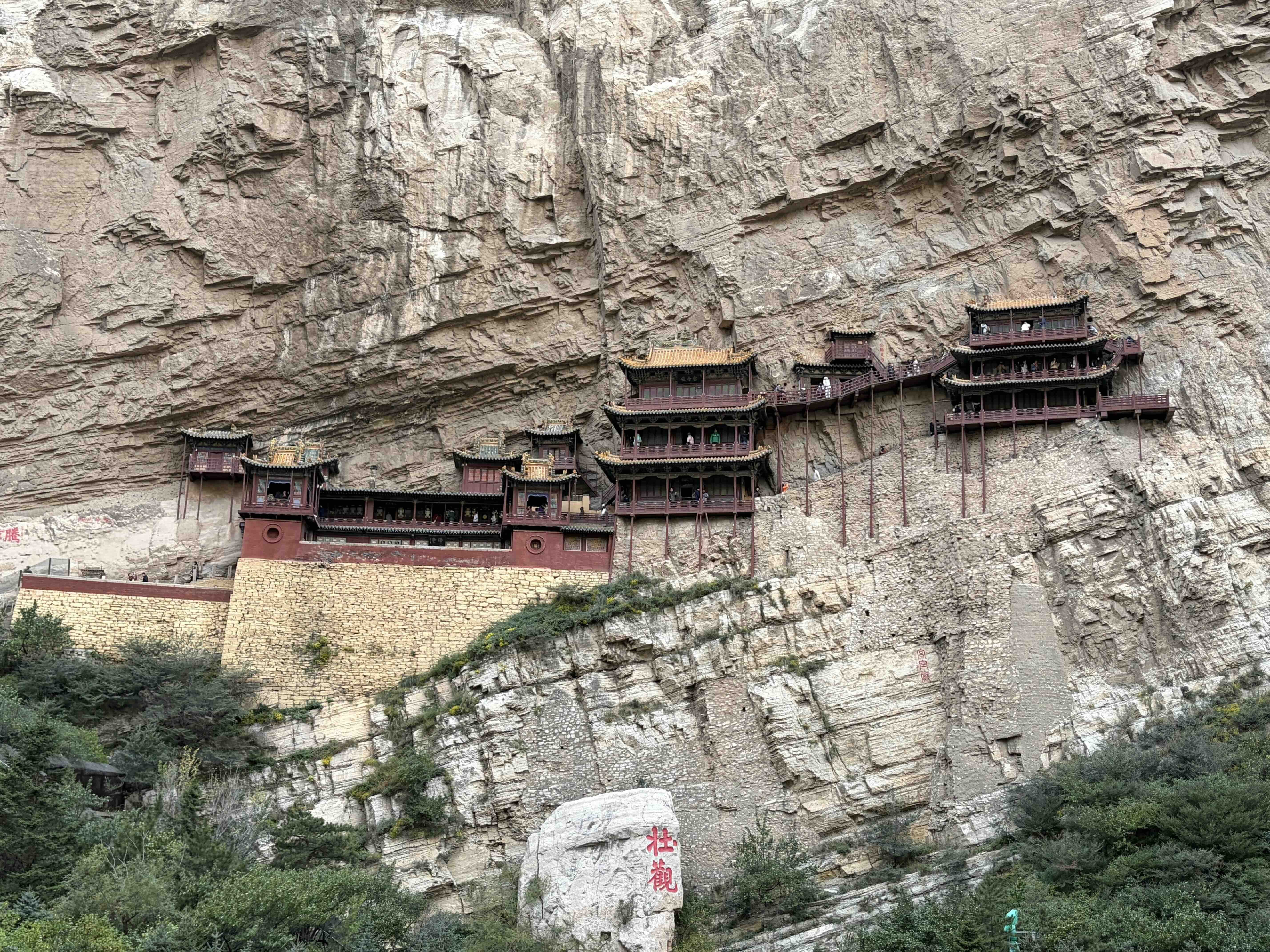
Hunyuan County town itself is actually decent—Yong’an Temple and Yuanjue Temple are both worth a look. Overall though, if you’re short on time and can’t score a climbing ticket for the Hanging Temple, making a dedicated trip out here from Datong isn’t really necessary.
Day 2: Yingxian Wooden Pagoda -> Yanmen Pass -> Shuozhou
Yesterday’s Hanging Temple was a bit of a letdown, and today’s Yingxian Wooden Pagoda scenic area basically just has the pagoda itself to see, so I was a little worried I’d be disappointed twice in a row.
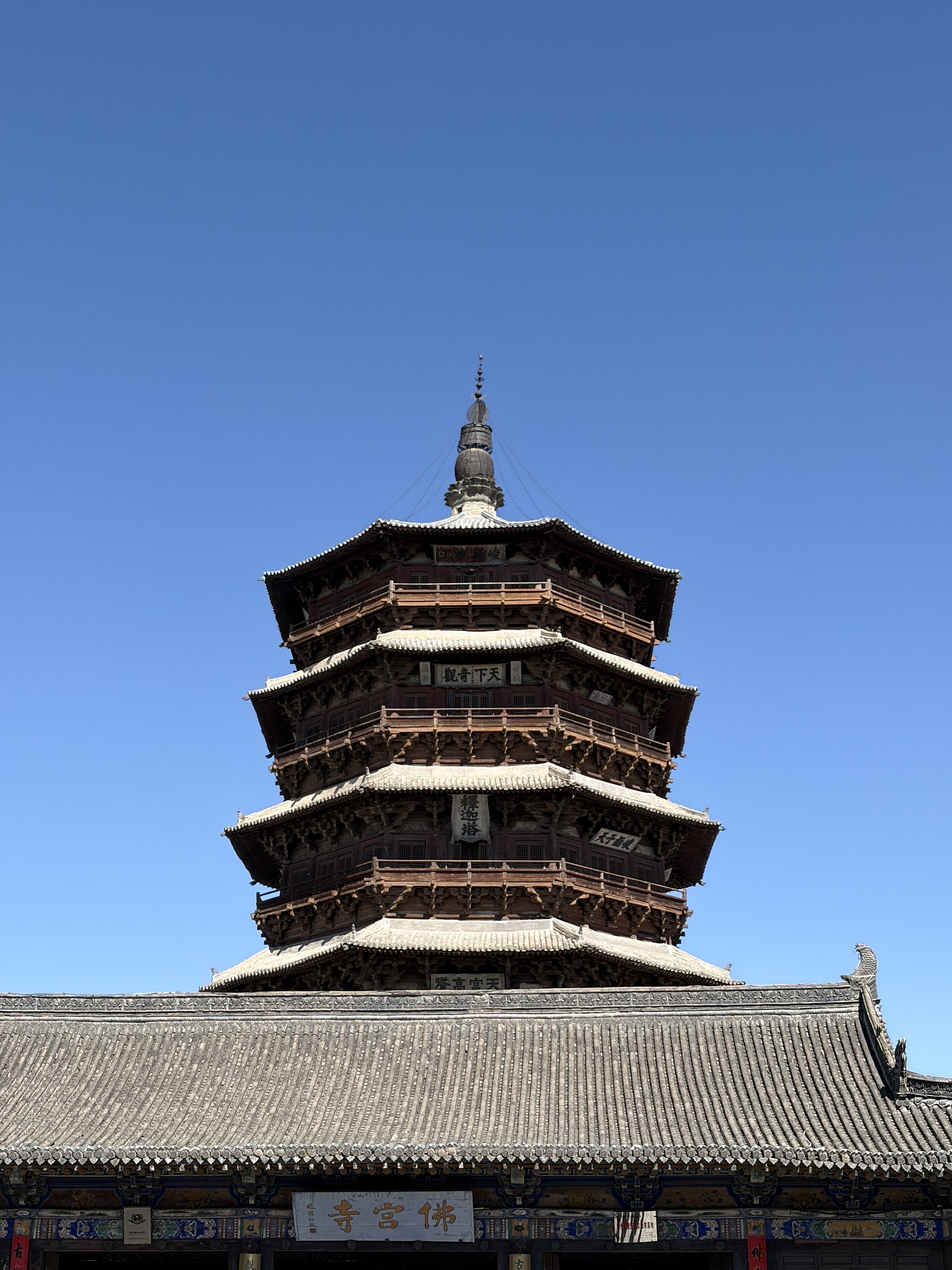
After getting off the highway and parking at the North Lot, it was another 10–15 minute walk to the entrance—I really didn’t expect the complex to be this sprawling. Fortunately, as soon as you walk around the side, the wooden pagoda comes into view, and it is genuinely gorgeous! Right outside the gate is yet another massive commercial street; scenic spots don’t make enough from tickets alone these days, so they have to monetize like this. On the flip side, you can tell how popular an attraction is just from how bustling its commercial street is…
Once you buy a ticket and step inside, you’re immediately struck by how massive the pagoda is. I don’t know anything about architecture, but I truly can’t think of any other ancient wooden structure built this tall. And it’s not just tall—it’s genuinely intricate and breathtaking. You could drop it straight into Age of Empires or Civilization as a Wonder and it wouldn’t look out of place at all. It looks stunning from every single angle. The only regret is that you can only view the ground floor and can’t climb up inside to truly experience the timber construction.
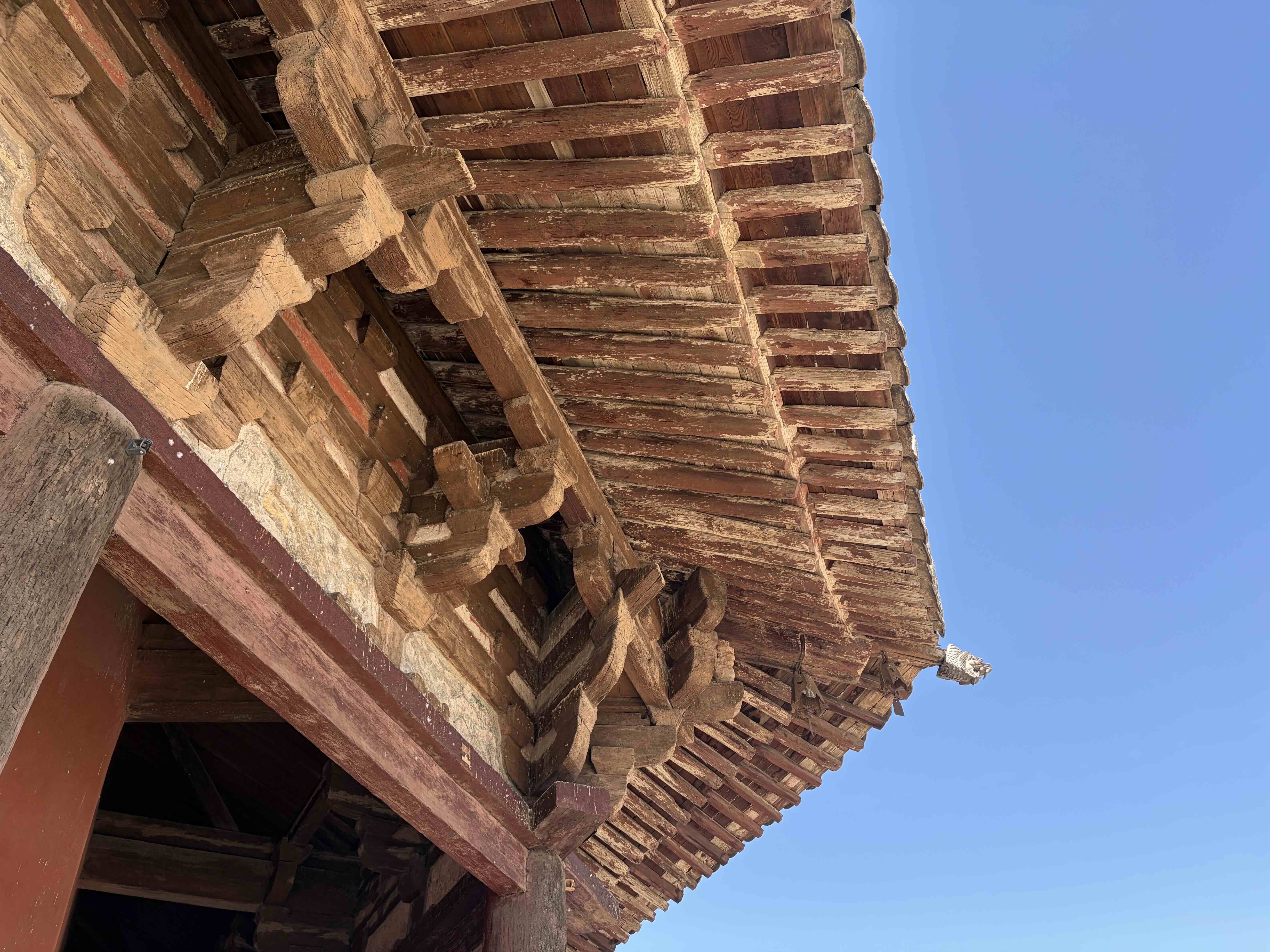
One super fun detail at the pagoda complex is that they built a mini “Cat Wooden Pagoda” right next to the real one😂. Probably because there are so many stray cats around, they decided to set up a little shrine for them too. Even though the craftsmanship is pretty rough and no cats were actually inside, the gesture itself is adorable and earns the place major bonus points.
By contrast, Yanmen Pass in the afternoon was painfully mediocre. Sure, this is historically where Yanmen Pass stood, but the current Great Wall here is blatantly newly built within the last few decades, with nothing particularly memorable about it. Even more infuriatingly, the shuttle bus at Yanmen Pass literally just drives 2 km on a flat road to drop you in front of a long commercial street, which everyone then has to walk all the way through just to reach the actual entrance. At Mount Heng I can at least understand needing shuttles due to heavy crowds and limited mountain parking. At Yanmen Pass, it’s purely a blatant, tacked-on cash grab—huge turn-off.
Day 3: Laoniuwan -> Youyu
Before the trip, I had never once seen any famous sights in Shuozhou or Youyu pop up on Xiaohongshu. I was a bit worried there wouldn’t be much to plan for today, yet to my complete surprise, today ended up being the biggest highlight of the entire trip.
Shanxi has three major scenic highways: Yellow River No. 1, Great Wall No. 1, and Taihang No. 1. Today’s route took us north along Yellow River No. 1 from Shuozhou all the way to Laoniuwan on the Shanxi–Inner Mongolia border, then east along Great Wall No. 1 to Youyu County. Near Laoniuwan is where Yellow River No. 1 and Great Wall No. 1 intersect—and also the starting point of Great Wall No. 1.
From Shuozhou you can take the expressway to Piantouguan, then exit onto smaller roads heading west straight to the Yellow River. Right when we reached the river, we hit our first “sight”: the Pianguan County Tourist Distribution Center. It’s actually a hotel + visitor center combo, with a 4- or 5-story hotel housing over 100 rooms. Yet today was Day 2 of the National Day holiday—literally peak travel season for the entire year—and when I pulled up, there were a grand total of 2 cars in the parking lot😂. The lot also had rows of reserved stalls for little shops, now just empty steel frames. Walking into the hotel, there wasn’t a single soul inside; the front desk was deserted, and it looked like the power wasn’t even turned on. Probably one of those leftover white-elephant projects from the big infrastructure boom years.
Further down the road, however, several viewpoints were genuinely stunning and well worth pulling over for.
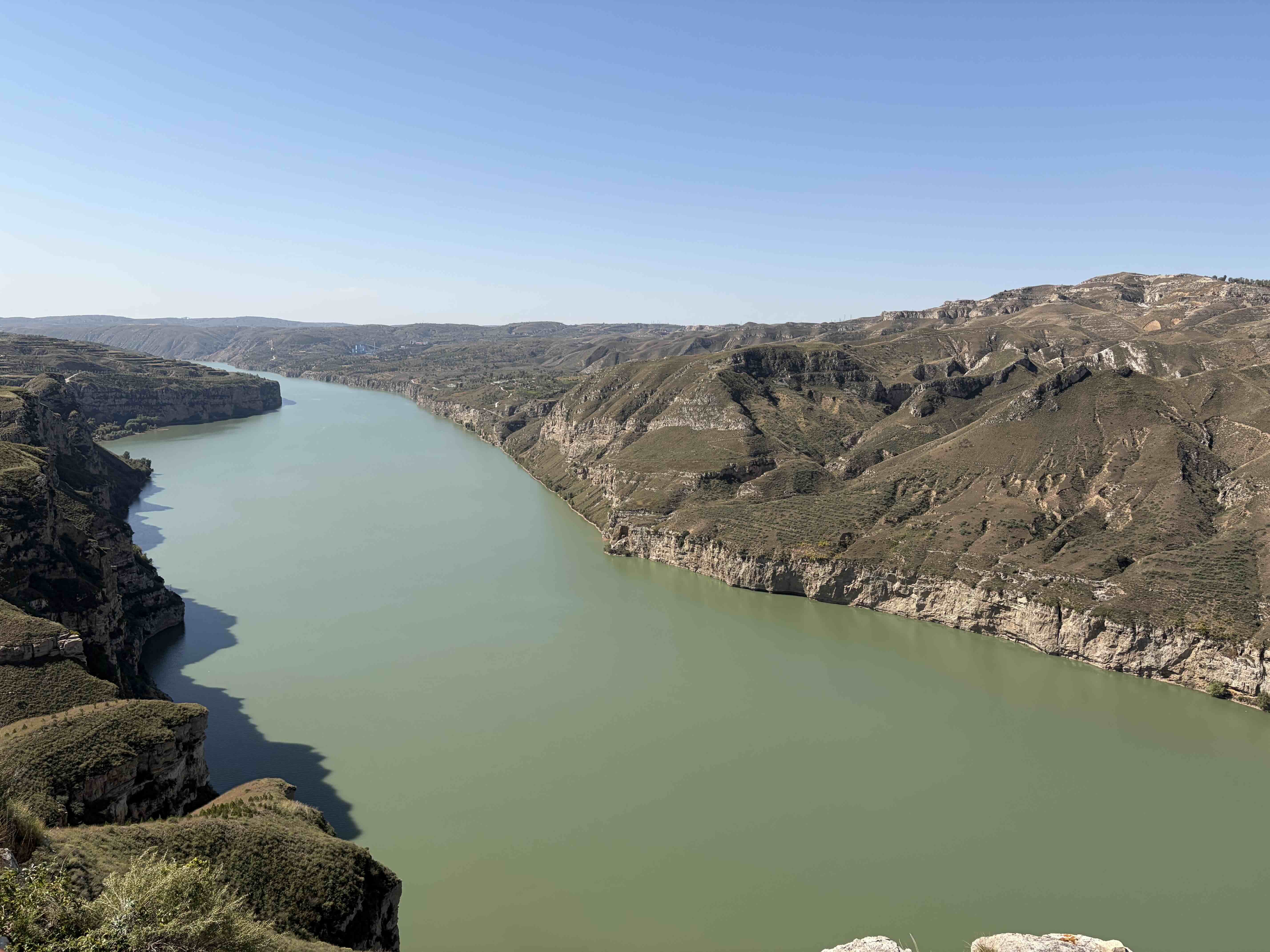
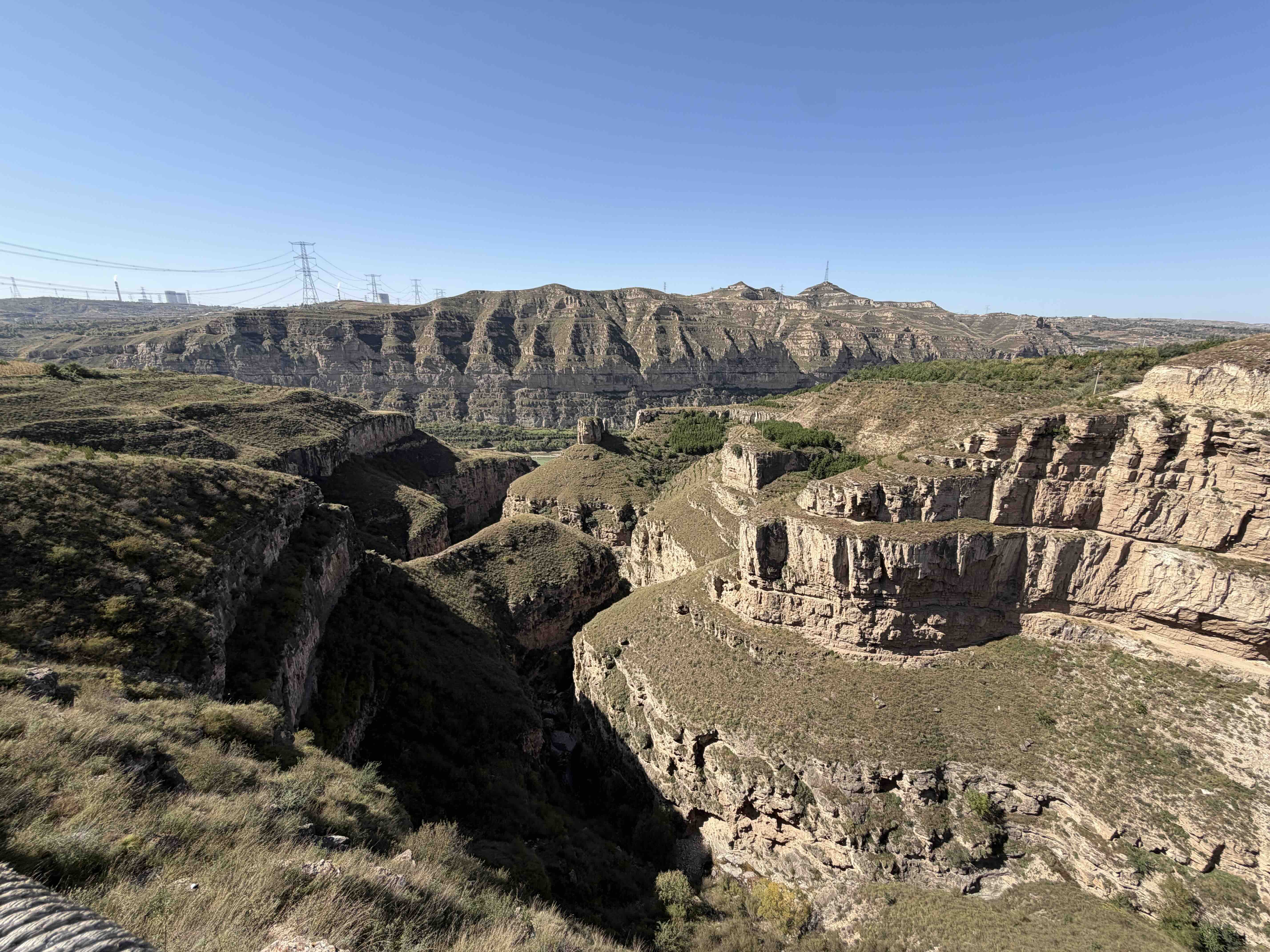
Next up was one of today’s main events: Qiankunwan (the other, of course, being Laoniuwan). A combo ticket for both Qiankunwan and Laoniuwan is 64 RMB—great value. Qiankunwan photographs just like China’s Horseshoe Bend. There are several viewing platforms within easy walking distance of each other, so you can stroll around at your own pace.
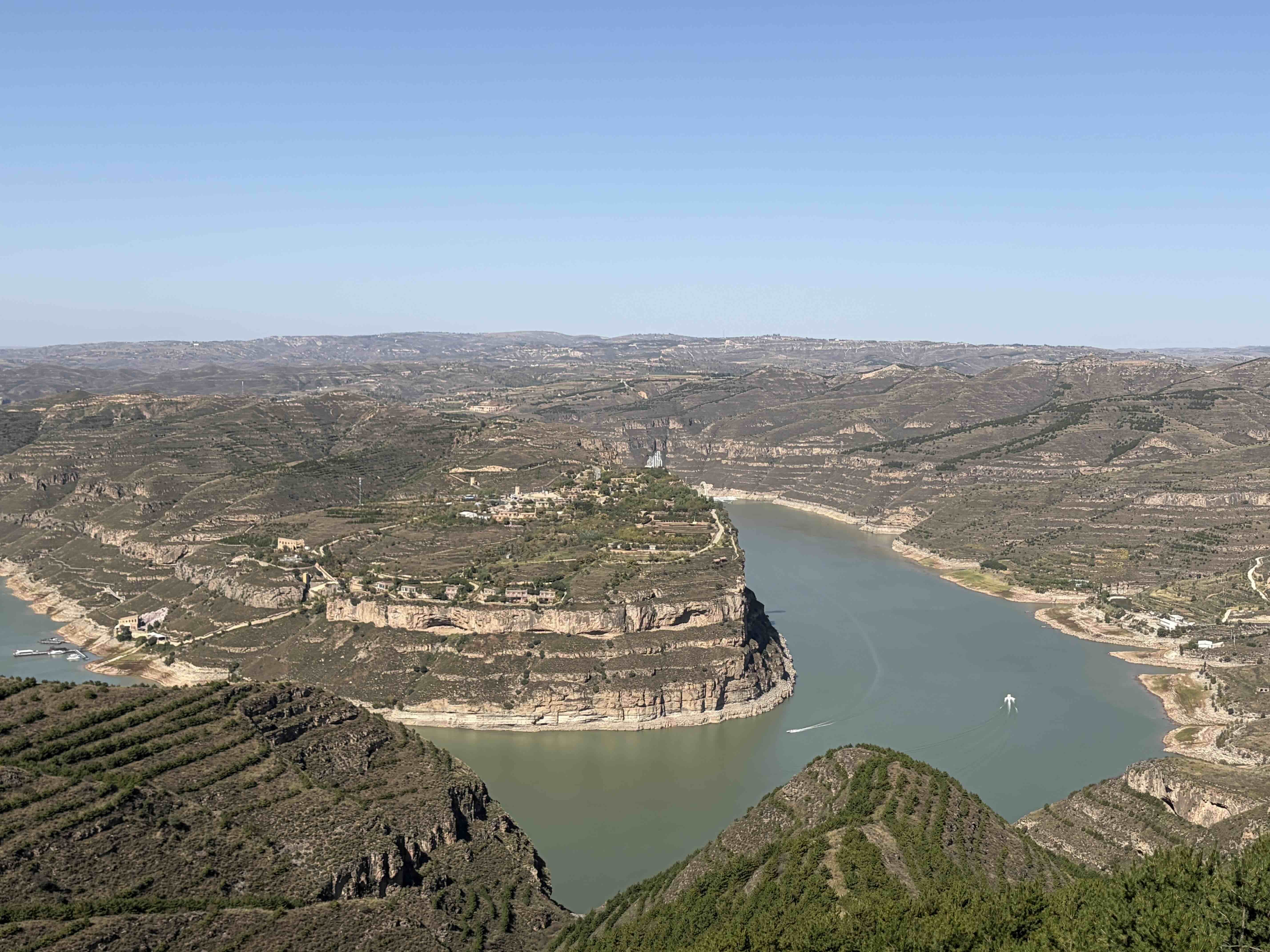
A bit further past Qiankunwan is Laoniuwan. This feels more like a full village turned scenic area, with cultural and historical stuff to see alongside the scenery. Compared to the nearly empty Qiankunwan and earlier viewpoints, this practically counted as a hotspot (the parking lot was almost full). Still, purely for views of the Yellow River, it’s actually not as impressive as Qiankunwan or those free roadside overlooks.
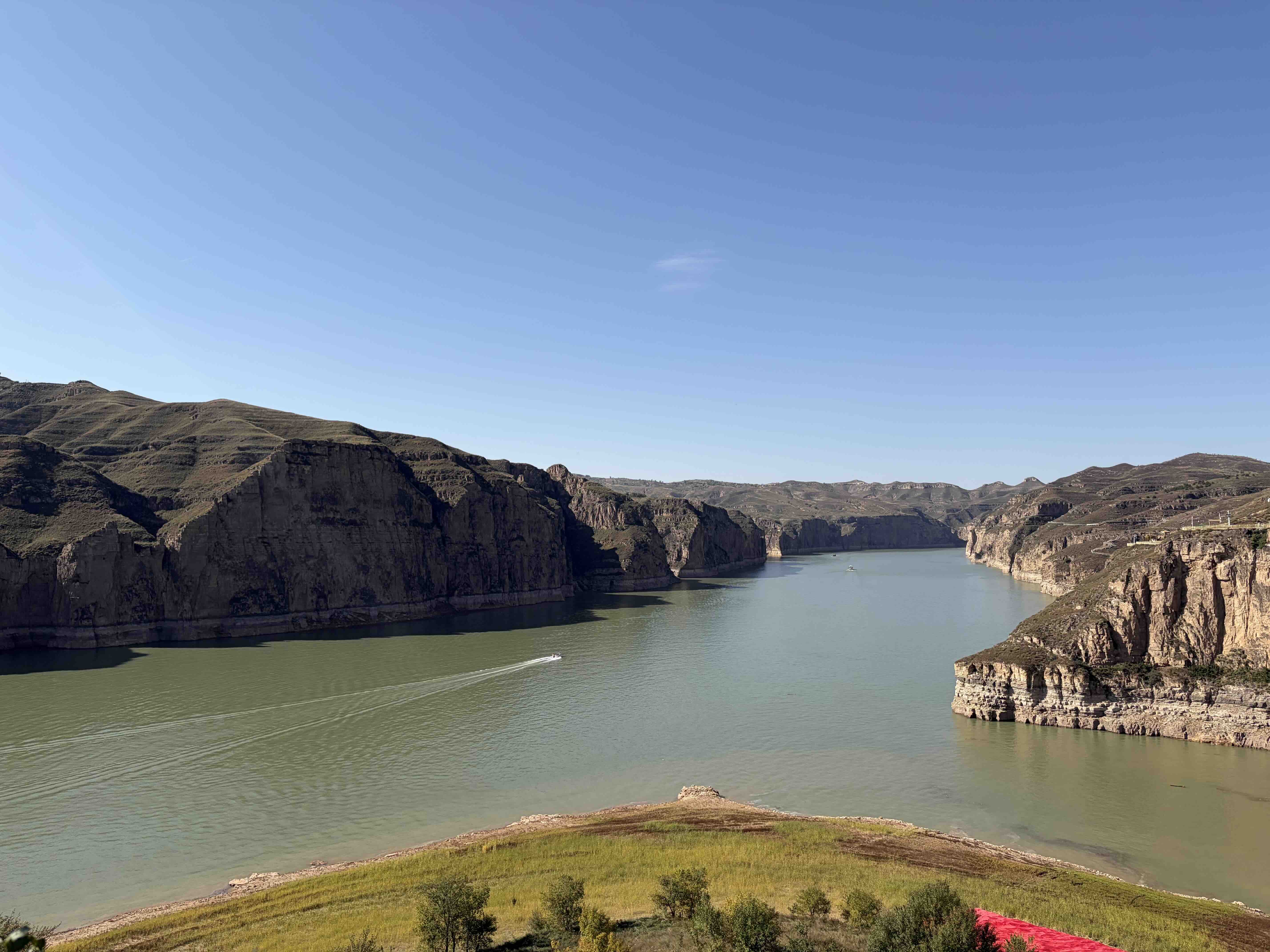
By the time we left Laoniuwan it was past 3 p.m., so we headed straight for Youyu County for the night. Along the way you can stop by the junction of Yellow River No. 1 and Great Wall No. 1. We drove a stretch of ridgeline road along Great Wall No. 1—hair-raisingly steep in places, but absolutely breathtaking. There were barely any other cars on the road, making it super relaxing to cruise and soak in the views.
Day 4: Sanshier Great Wall -> Shahukou -> Bataizi Church -> Datong
Strong winds were in the forecast today. Stepping out in the morning, dead leaves were swirling everywhere, adding an extra layer of bleakness to Youyu, a county town that already looked pretty quiet and weathered.
Getting out of the car at Sanshier Great Wall, the wind immediately tried to blow us off our feet. This place is hands-down another hidden gem of Shanxi—you can see crumbling, heavily weathered sections of the Ming Great Wall scattered across the hills. Looking at the Great Wall here gives you a real sense of historical weight, making you imagine the soldiers who once guarded these ridges. By comparison, newly rebuilt “retro” sections like Yanmen Pass feel like a movie set.
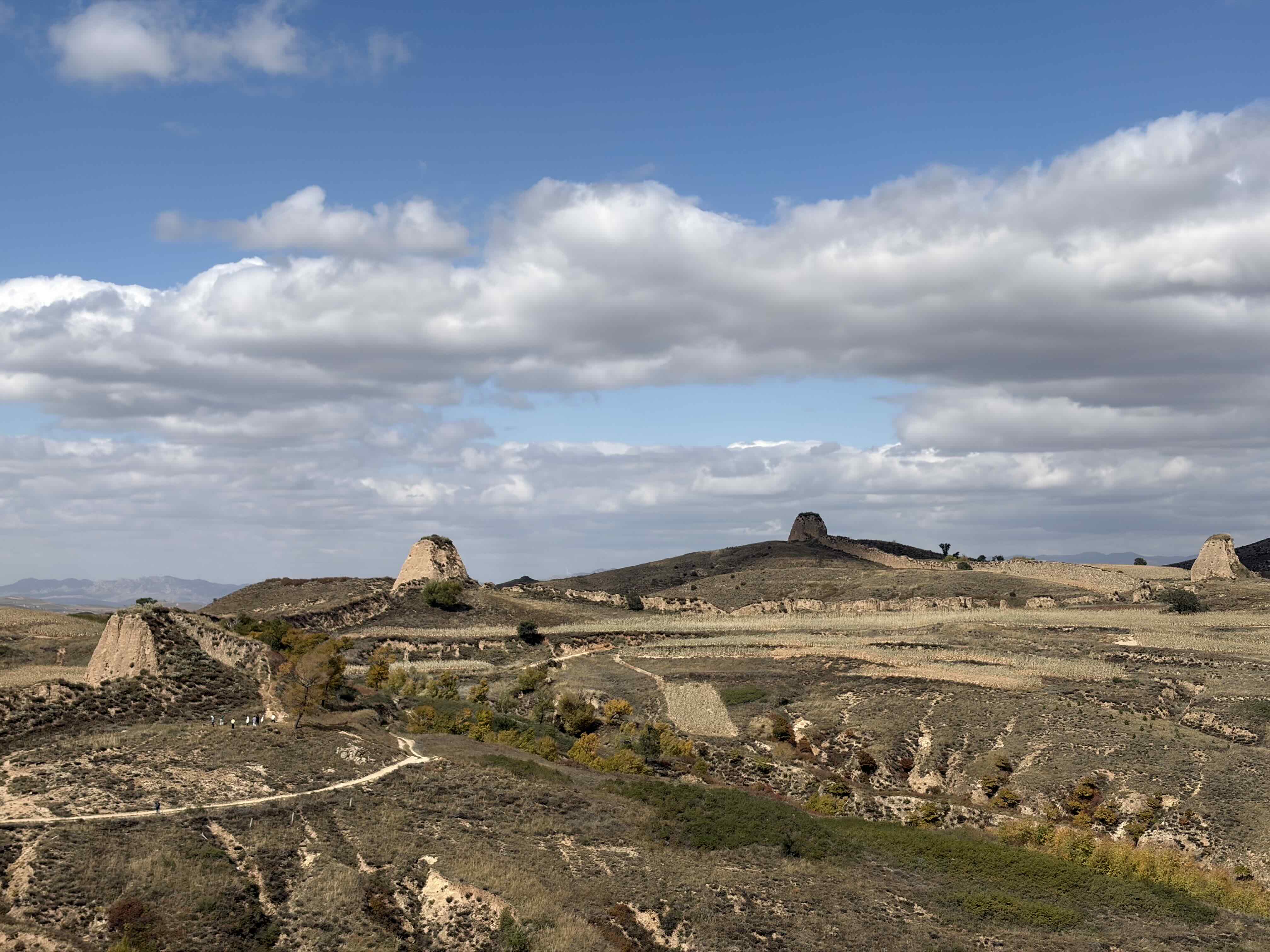
Shahukou is also a completely newly rebuilt attraction—just snap a quick photo to mark the historic starting point of the “Zou Xikou” migration and call it a day. The Youyu County Museum next door is worth a quick stop too. There weren’t many tourists here either; along the long row of shops on the commercial street, only the 2 or 3 closest to the gate were still open. You couldn’t even find a proper sit-down indoor restaurant. If foot traffic looks like this during National Day week, they might as well declare bankruptcy.
Leaving Shahukou, we continued east along Great Wall No. 1. This stretch had practically zero traffic—over more than an hour of driving, we saw maybe 2 other cars. We passed two viewpoints along the way. The road to the first one looked super sketchy, though we did eventually find the photo spot. For the second viewpoint we saw a road sign, turned off No. 1, and then never saw another sign again—after driving 2–3 km we ended up on an unpaved village dirt track… clearly we missed it. Finally, approaching S210, we climbed over a mountain pass and snapped a panoramic shot of the switchbacks from a summit overlook.
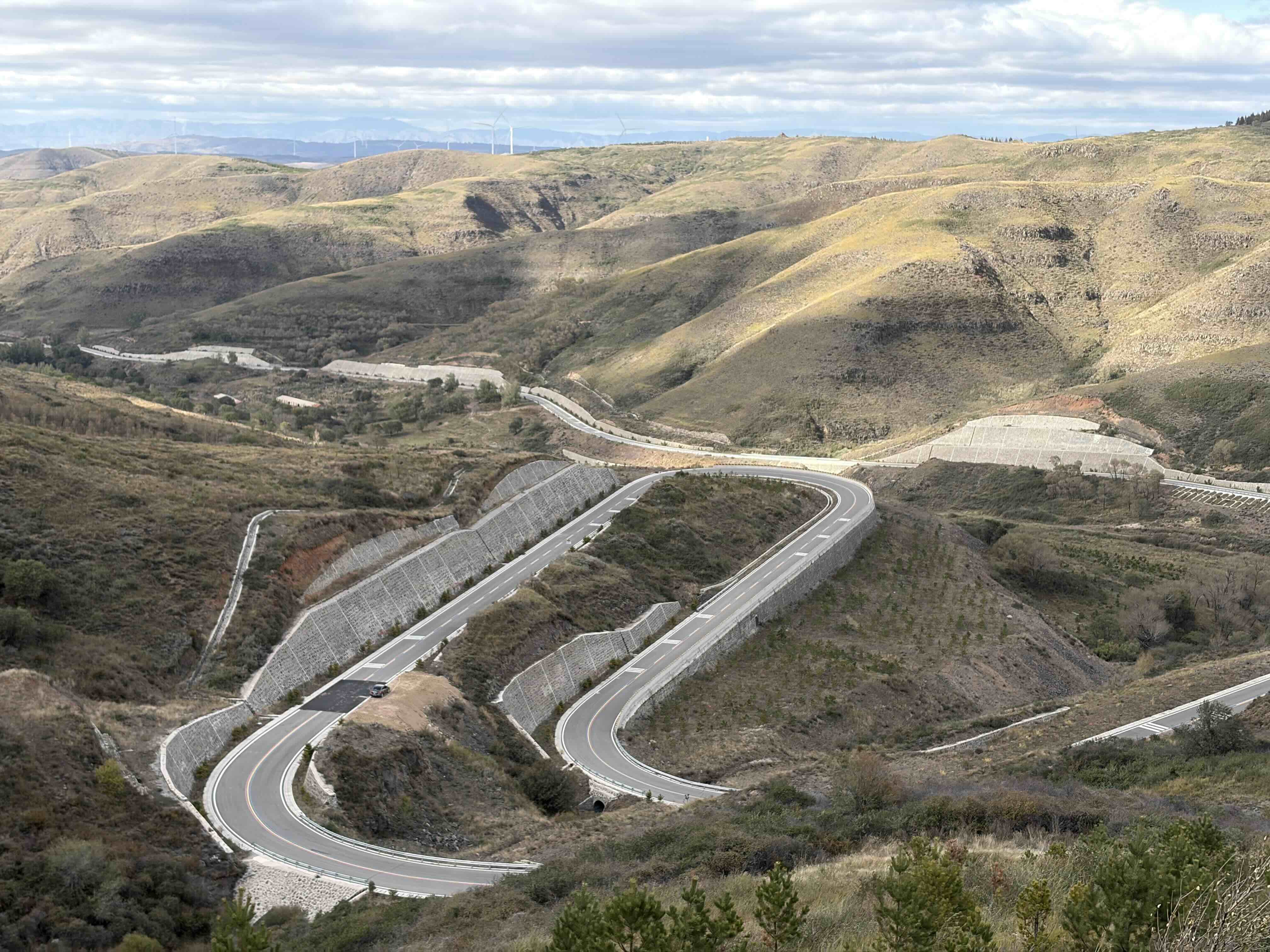
From there it was switchbacks all the way back down to the expressway on the Datong Plain. Our next stop was Bataizi Church in Bataizi Village. Honestly though, I didn’t find it all that interesting (not even enough to include a photo)—basically a quick photo-op and leave. Yet somehow this spot is super popular; there was even a traffic jam lining up for the parking lot. Meanwhile, an incredible place like Sanshier Great Wall barely had anyone there—such a shame.
Day 5: Datong Ancient City -> Taiyuan
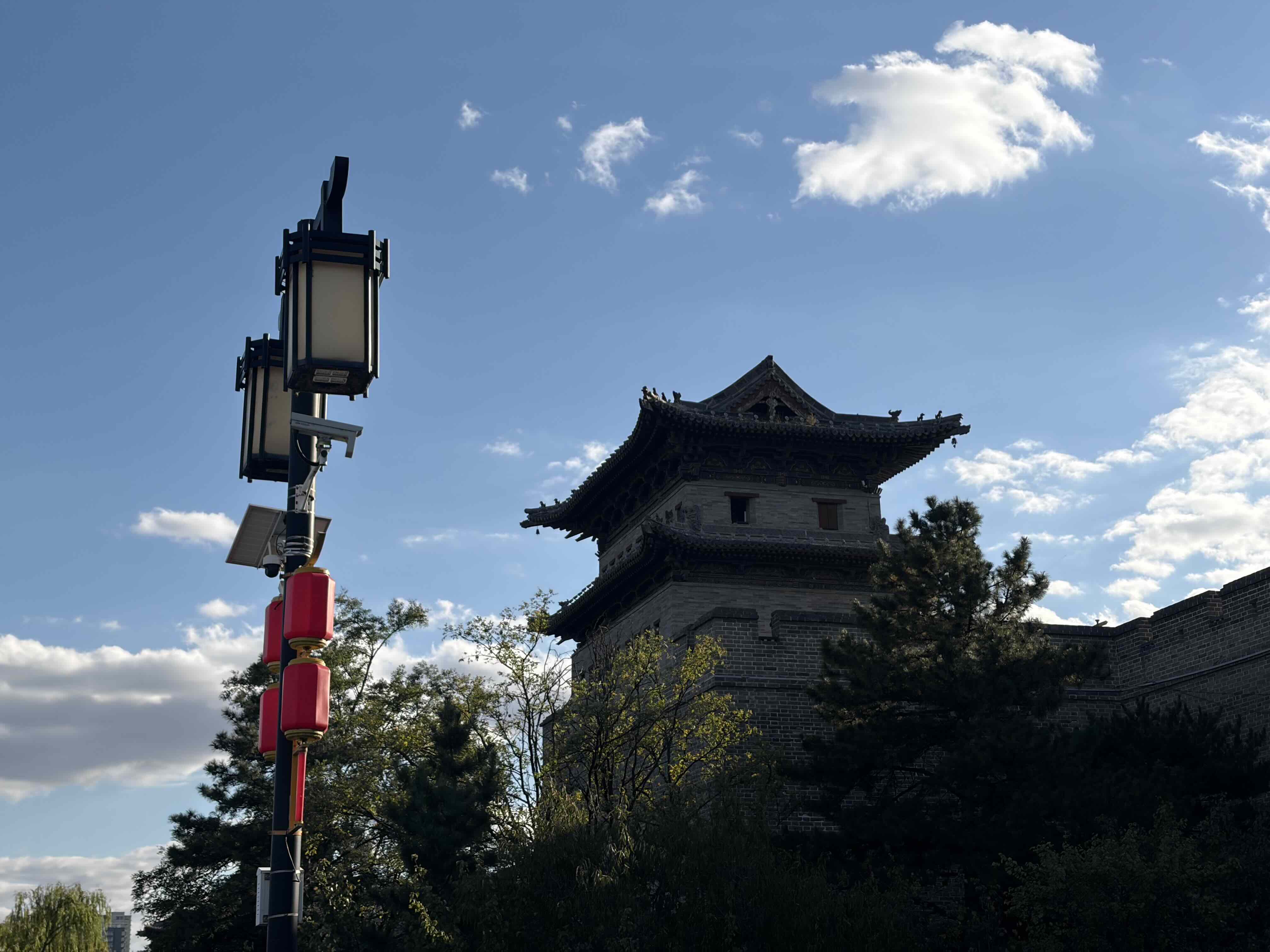
Datong Ancient City is essentially the innermost walled section of downtown Datong. Once I got there I realized it’s actually pretty big—roughly 10 square kilometers? Inside, it’s not just the traditional old-town architecture you’d expect; part of it still looks like the old residential core of a typical third-tier Chinese city. No idea whether they plan to eventually tear those older buildings down and rebuild everything in antique style. To be fair, though the renovated old-town part is heavily commercialized, the architectural aesthetics are genuinely on point. It also contains major sights like Huayan Temple and Shanhua Temple.
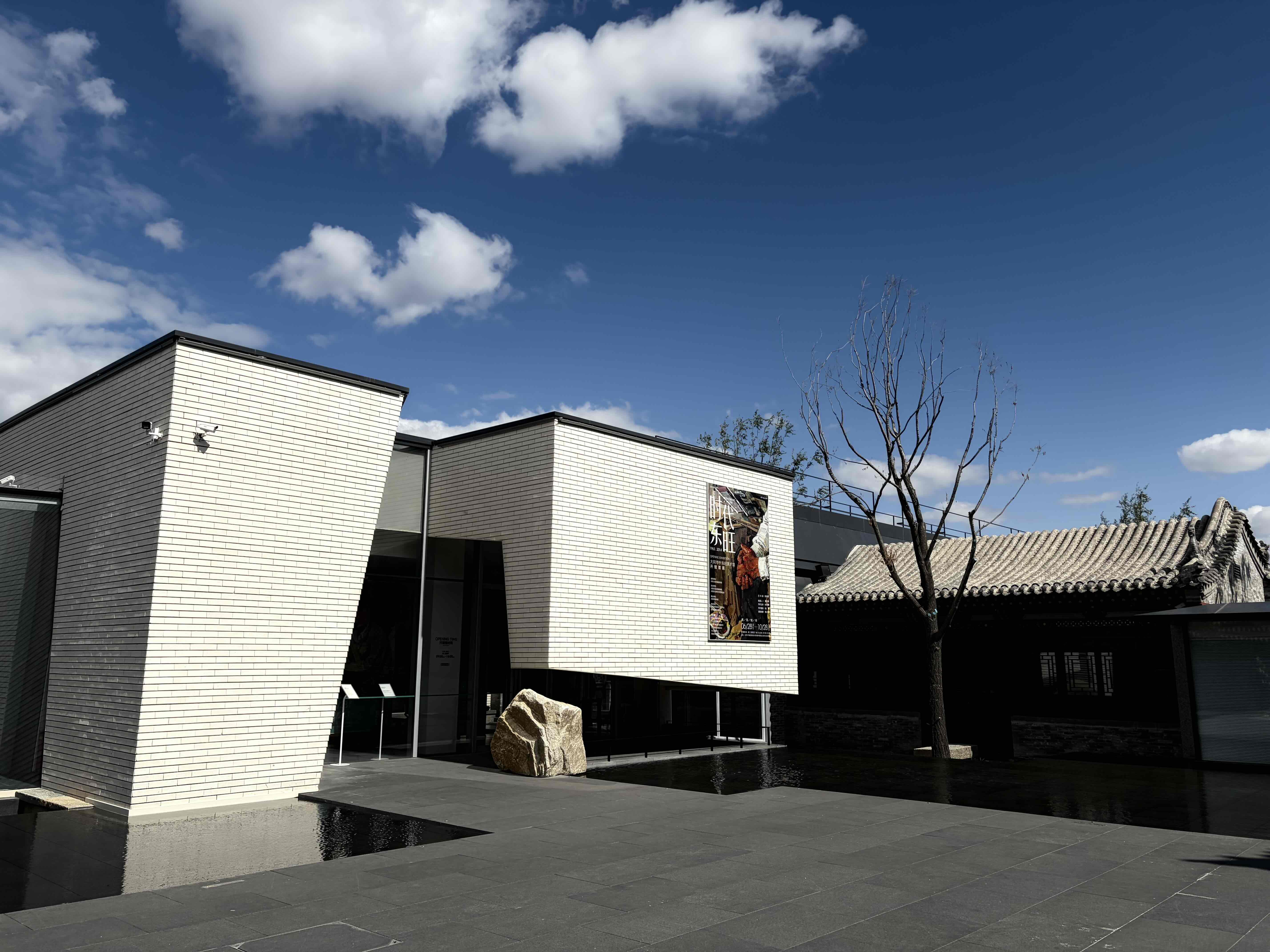
While wandering aimlessly through the old town, I stumbled across a really well-designed building. Walking up, it turned out to be the Xin Dongwang Art Museum. I went inside for a stroll—it’s filled with works by the artist Xin Dongwang and was surprisingly engaging.
There’s also a section inside the walled city called “Dongnan Yi.” Not sure why this particular pocket has its own name, but it gets rave reviews on Xiaohongshu as one of the best old-town neighborhoods in China. It really does have a lot of stylish, thoughtfully designed shops that are fun to browse.
Overall we just had a super chill day hanging out around here without hitting any major sights, then caught the 6 p.m. high-speed train back to Taiyuan.
Day 6: Jinci Temple
No matter how great an attraction is, once it’s packed with people, the experience is ruined.
No matter how great an attraction is, once it’s packed with people, the experience is ruined.
No matter how great an attraction is, once it’s packed with people, the experience is ruined.
My original plan in Taiyuan was to visit both the Shanxi Museum and Jinci Temple, but since I couldn’t snag a reservation for the Shanxi Museum, Jinci Temple was my only stop. Unfortunately, Jinci today was absurdly crowded. There was no line to enter Jinci Park itself, but the park inside was shoulder-to-shoulder. For Jinci Museum, we had to queue 40 minutes just to get in—I honestly can’t even remember the last time I waited that long for a tourist attraction.
Jinci really should be a fascinating place, yet with that many people, there was zero enjoyment to be had. You couldn’t slow down and take anything in; you were just being swept along by the crowd. After seeing 2 or 3 spots I completely lost patience and just wanted to get out of there and go sit down with a cup of coffee.
Road Tripping in China
This was my first time doing a long-distance road trip in China. Before I left, at least two friends from Shanxi warned me to be extra careful driving here, because people don’t really follow the rules and there are tons of semi-trucks😂. So I only planned to drive around the sights outside Datong, and stuck to ride-hailing inside Datong and Taiyuan.
Frequent lane-changing without using turn signals is basically a nationwide issue in China, though tier-1 cities like Beijing and Shanghai are a bit better. That said, in Shanxi I genuinely barely saw anyone use a turn signal—Chengdu isn’t great either, but it still felt slightly better than here.
The sheer number of semi-trucks might be a Shanxi specialty. On the expressway it was relatively manageable, but on the way to Youyu I drove a stretch of National Highway G109, and without any exaggeration, I was completely surrounded by big rigs the entire way. On a 60 km/h road, passing 100 oncoming semi-trucks in an hour is not an exaggeration. Trucks on the expressway here also have a weird habit of driving with their right wheels over the line, hugging the right guardrail. Normally that’s fine—it gives the left lane more room—except the drivers don’t even move back over at on-ramps. One time merging onto the highway, a semi was encroaching a quarter of the way into my merge lane and practically grazed my car. Scared the hell out of me.
I also ran into a few things that seemed completely wild to me—not sure if they’re unique to Shanxi or common across China:
- Once a car was driving the wrong way down the frontage road, so I had cars coming straight at me on both my left and my right😂.
- I saw people run red lights at least 3 times—and not just one car, basically a whole bunch of cars just went right through because there wasn’t much traffic and no cameras…
- Nobody seems to pick their lane based on speed. You’ll see someone cruising at 40 km/h in the far-left lane of an 80 km/h road, and on the expressway slow cars just camp in the passing lane without a care in the world. (Sure, this happens everywhere to some extent, I was just shocked to see it so many times in just 4 days of driving.)
Now that the bad stuff is out of the way, here are the great parts about road tripping in China:
I rented a Tesla this time, and when picking it up, CAR Inc. told me the car couldn’t use Tesla Superchargers and had a max range of only 400 km. Even though I wasn’t driving huge distances each day, I was still pretty anxious about range and charging. Once I hit the road, though, I discovered charging in China is insanely convenient. At least in Shanxi, highway rest stops—and even ordinary tourist spots—have plenty of chargers. Even crazier, almost all of them are fast chargers. Chinese Teslas come with both charging port standards, and I didn’t encounter a single incompatible plug the entire trip. Super seamless!
Overall highway conditions were also pretty good, and free expressway tolls for passenger cars during National Day week is awesome! Digitized parking lots, plus scanning a QR code to charge without needing to download a bunch of separate apps, all make road tripping a breeze. Picking up and returning the rental car was super smooth too—even faster than in Canada or the US. For anyone used to road tripping in North America, as long as you’ve got the nerve to drive here, you’ll adapt seamlessly.
Cities
As the plane was descending into Taiyuan, looking out the window at the buildings below, I already felt something looked very different. Before coming to Shanxi, I had imagined seeing lots of older 6-story walk-ups. Instead, looking down at Taiyuan from the air, you see endless 20- to 30-story residential high-rises—and they look uncannily alike. Not literally identical, but the architectural style and color palette across the whole city are so uniform that it looks like the building templates generated when you zone “High-Density Residential” in an old SimCity game. The high-rises are so rigid and densely packed it genuinely triggers a bit of trypophobia. Too bad I didn’t get a photo from the plane, so here’s an image from online to give you the idea.
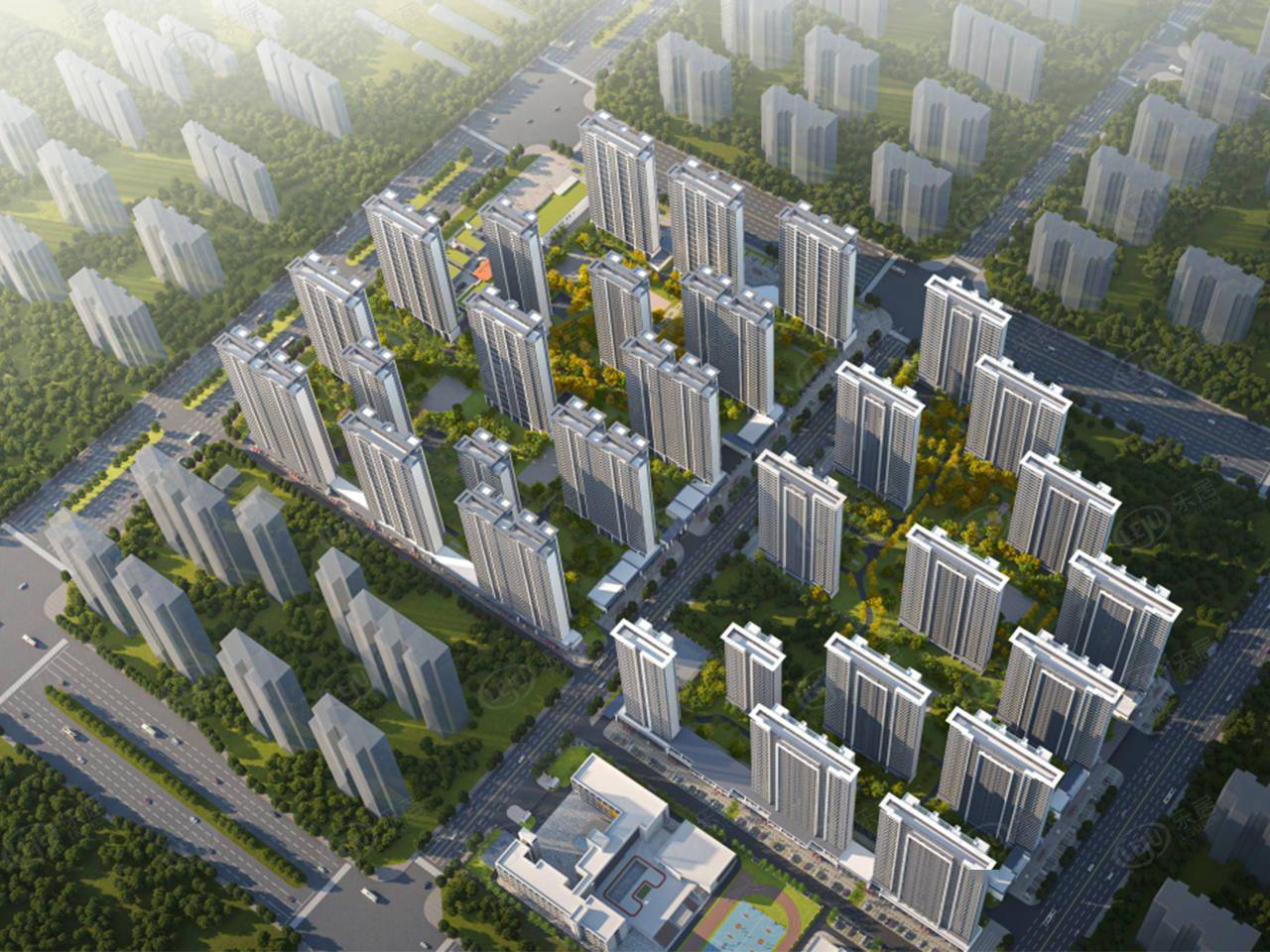
(In reality the buildings look a bit older than this render, with more yellowish/earthy tones and far less greenery, but the overall style and layout are pretty much just like this.)
And in Datong, this architectural style gets cranked up even further. In Taiyuan you still occasionally see glass facades or lower-rise buildings. In Datong, no matter where you go, you’re surrounded by the exact same high-rises. For some reason, that extreme uniformity kept reminding me of planned economies and Soviet aesthetics😂.
Aside from the architecture, the other thing in Datong that left a very, very, very deep impression on me was street parking. Right as the high-speed train pulled into Datong, I saw the streets outside packed wall-to-wall with parked cars. At first glance I thought it was a parking lot or a used-car market, but as the train kept going, the densely packed cars stretched on and on. Once I started driving myself, I realized this was everywhere across the entire city. A typical street has 3 parallel rows of “parking”:
- Outside the frontage road, in the rightmost lane of the main road—cars park right up against the divider.
- Inside the frontage road, cars also park along the divider. Since frontage roads are usually about two cars wide, other cars can still squeeze past slowly.
- On the sidewalk. Actually I’m not even sure if it counts as a true “sidewalk,” since I noticed many sidewalks here have painted parking lines, meaning cars are officially allowed to drive up and park there.
In Chengdu or Shanghai, you’d only see this kind of triple-layer parking on very, very, very rare occasions. In Datong, it’s as natural as breathing—outside scenic spots, outside shopping streets, outside hotels, everywhere.
Random Thoughts
- Shanxi has tons of wind turbines and solar panels—you’re constantly driving along and suddenly seeing whole hillsides covered in them in the distance. Super impressive.
- Shanxi has a Grand Canyon, a Horseshoe Bend, and even a place called Phoenix City—so Shanxi == Arizona, confirmed!
- Taiyuan has lots of Datong restaurants, while Datong has no Taiyuan restaurants—does that mean Datong cuisine is more famous than Taiyuan cuisine?
- There doesn’t really seem to be a unified “Shanxi cuisine”; Shanxi specialties are basically all noodles and various wheat-based snacks and desserts.
- Bigger Shanxi restaurants here are all named “Something Banquet,” like “Datong Banquet” or “Taiyuan Banquet.” Apparently it’s because people usually only go out for a formal Shanxi meal when hosting guests; for casual hangouts with friends, you just grab a quick bowl of noodles or eat another regional cuisine.